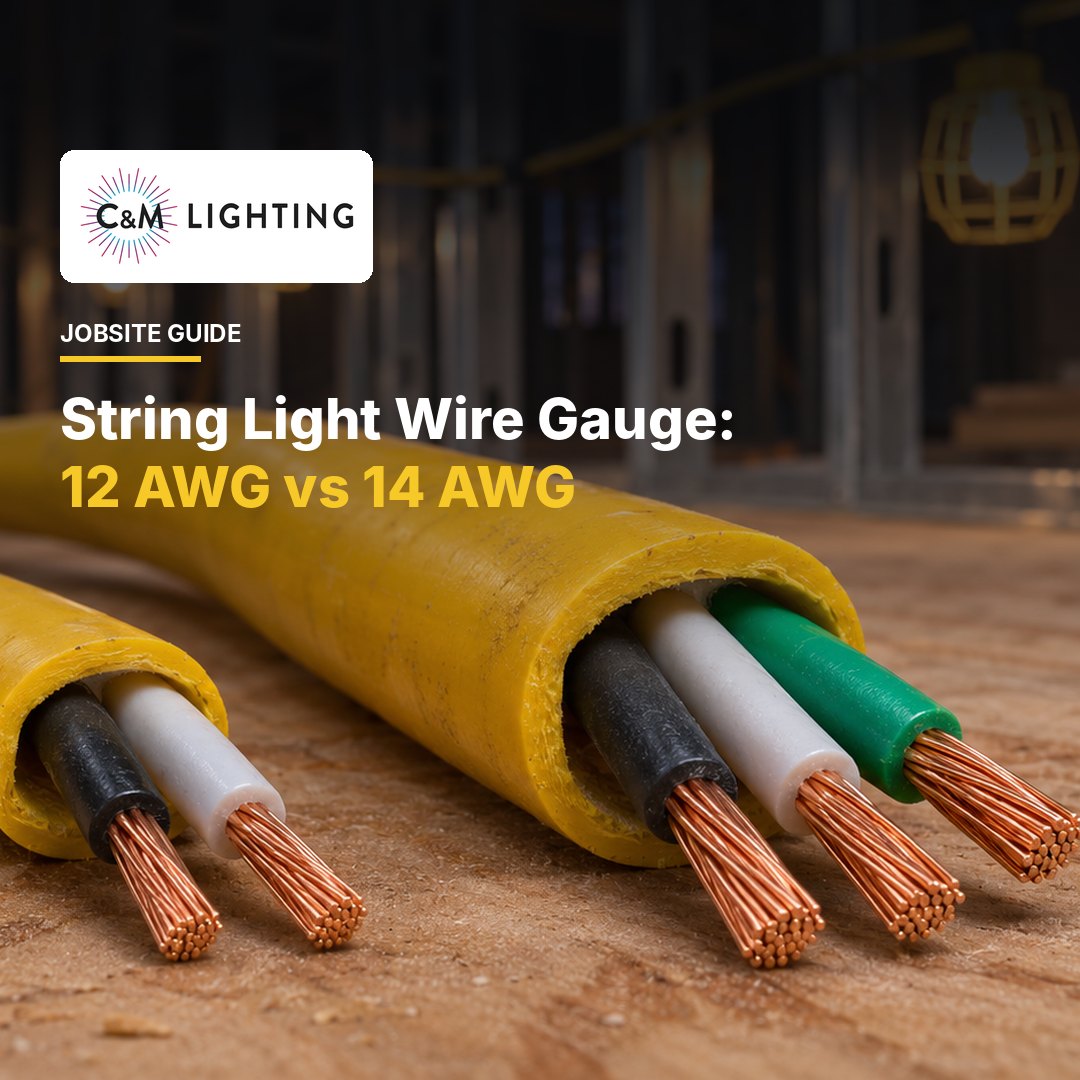
Construction string lights look alike from a distance, but the cord is what decides how far you can run them, how many you can link and where you can use them. This guide explains the markings on a stringer’s cord and how to pick the right gauge for a job.
Reading the cord: what 14/2 SJTW means
- 14 is the wire size in AWG (American Wire Gauge). Smaller numbers mean thicker copper, so 12 AWG is heavier than 14 AWG.
- /2 or /3 is the number of conductors. A /2 cord carries two current-carrying wires. A /3 cord adds a third, usually the equipment ground.
- S marks service cord, J marks junior service (rated 300 volts), T means a thermoplastic jacket and W means it is rated for outdoor and wet use.
So 14/2 SJTW is two-conductor, 14-gauge, 300-volt thermoplastic cord rated for outdoor use, which is what you want on an open jobsite.
Why gauge matters: current and voltage drop
Thicker wire carries more current and loses less voltage over distance. As a general guide, flexible cord in 14 AWG is commonly rated for about 15 amps and 12 AWG for about 20 amps. Check the rating printed on the cord or the product’s spec sheet for the exact figure.
LED stringers draw far less current than old incandescent strings, which changes the math. A 100 ft string with ten 12W LED lamps draws about 120 watts, roughly 1 amp at 120 volts. At that load, voltage drop over 100 ft of 14 AWG copper is about half a volt, which LED lamps will not notice. With incandescent lamps at 100W each, the same string would draw over 8 amps, and voltage drop would become a real limit.
When to choose 12 AWG over 14 AWG
- Long daisy-chained runs. Every string you add carries the current of all the strings after it, so the first cord in the chain sees the whole load. Heavier gauge leaves more headroom.
- Mixed loads. Size the cord for the lamps on the run. Under OSHA rules, temporary lighting circuits are for lighting only, so tools and heaters belong on a separate circuit.
- Heavy-duty sites. Thicker cord is tougher against abrasion and crushing.
Whatever the gauge, never link more strings than the manufacturer’s rating allows, and keep the total load within the circuit’s capacity. Continuous loads such as lighting should stay at or below 80% of the breaker rating.
2-wire or 3-wire?
A 3-wire (/3) stringer carries an equipment ground through the run. Some job specs and general contractors require grounded stringers, so check the site requirements before ordering. Both types still need GFCI-protected power on a construction site.
Picking a stringer
- Standard floors and corridors: 14 AWG is the usual choice for LED stringers on typical runs. The SL10-100 is 100 ft of 14/2 SJTW with ten caged 12W LED lamps included, ETL listed to UL 1088, the safety standard for temporary lighting strings.
- Longer chains or grounded runs: step up to a 3-wire stringer. The SL14-3 is 100 ft of 14/3 SJTW, and the SL12-3 moves up to heavier 12/3 SJTW. Both carry an equipment ground and are ETL listed to UL 1088. See every model in the SL Series.
- Areas that need concentrated light: add a caged work light such as the CM7-100.
Wire gauge FAQ
Can I use 14/2 wire for lights?
For most LED stringers, yes. 14/2 SJTW is two-conductor cord with no equipment ground, and a 100 ft string of ten 12W LED lamps draws only about 1 amp. Use a 3-wire stringer such as the SL14-3 or SL12-3 where the job calls for grounded stringers, and plug either type into GFCI-protected power.
12 AWG vs 14 AWG: which stringer do I need?
14 AWG flexible cord is commonly rated for about 15 amps and 12 AWG for about 20. For a single LED stringer, 14 AWG is plenty. Choose 12 AWG for long daisy chains, where the first cord carries the whole run’s load, or on heavy-duty sites where tougher cord lasts longer.
Not sure which gauge fits your project? Request a quote with your run lengths and how many strings you plan to link.