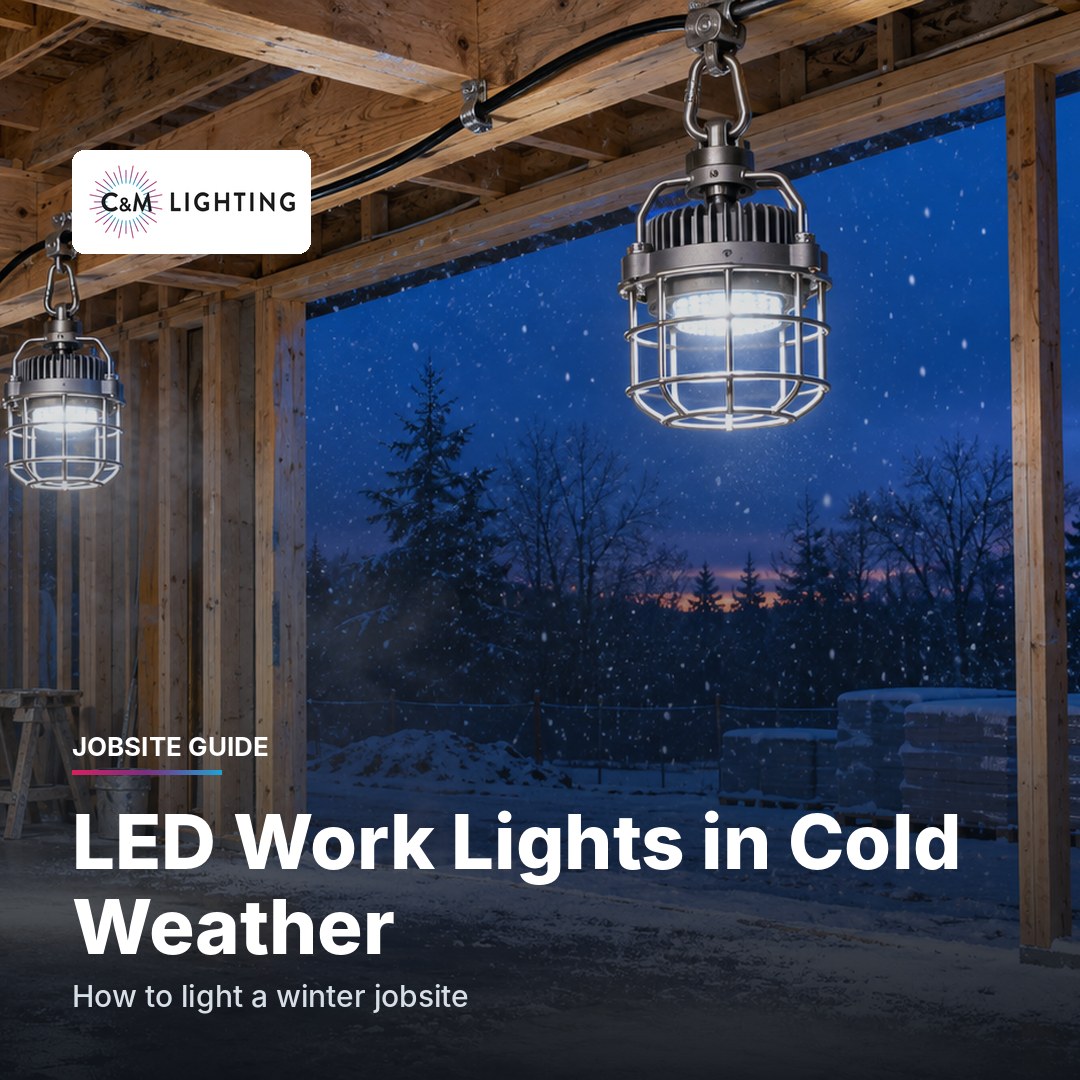
In winter, the light runs out before the work does. By late afternoon most crews are working under temporary lights, often in freezing temperatures, with heaters pulling on the same circuits. The lights you hang have to come on instantly, stay on when the power blinks, and shrug off snow and condensation. That’s where LED work lights pull far ahead of the metal halide fixtures many sites still run.
Cold is hard on metal halide
Metal halide lamps don’t come on at full brightness. They need a warm-up period, and if the power drops, even for a second, they need to cool down before they’ll restart.
Metal halide
LED work light (CM7-100)
Warm-up to full light
2–4 minutes typical; some 400W probe-start lamps take 10–15
Instant
Restart after a power blip
5–7 minutes (pulse-start) to 10–20 minutes (probe-start)
Instant
Rated operating range
Varies by lamp and ballast
-22°F to 140°F
On a winter site, power blips are common. Temporary heaters cycle on and off, generators get refueled, and a tripped breaker takes a whole run down. With metal halide, every one of those means minutes of darkness while the lamps restrike. With LED, the lights come back the moment the power does.
Cold actually helps LEDs
Heat is what wears out an LED, so cold weather is on its side. A cold fixture sheds heat more easily, which is easier on the LEDs and the driver. What matters is the fixture’s rated operating range, and the CM7-100 is rated to run from -22°F to 140°F. That covers a January pour in Minnesota and a July roof in Texas with the same light.
Snow, slush and condensation
Winter sites are wet even when it isn’t raining. Snow blows in through open walls, slush gets tracked across slabs, and condensation forms on anything that warms up and cools down. A work light needs to be sealed against all of it.
The CM7-100 is rated IP65: dust-tight and protected against water jets from any direction. Its aluminum body sits inside a stainless-steel cage, so a dropped tool or a bumped ladder doesn’t end its shift.
The early dark still has to meet OSHA
OSHA’s minimum lighting levels for construction don’t change with the season. When daylight is gone by 4:30, more of each shift has to meet them under temporary light alone. Our guide to OSHA jobsite lighting requirements lists the minimums by area and shows how to plan fixtures to meet them.
A single CM7-100 puts out 14,000 lumens from 100W, so you can light more of a floor from each circuit than you could with metal halide.
Winter setup checklist
Give lights their own circuits. Keep temporary heaters off the circuits that feed your lights, so a heater trip doesn’t black out the floor.
Check cords before every cold shift. Cord jackets stiffen in the cold. Look for cracks and cuts, especially at the plugs.
Keep connections off the ground. Hang lights and route cords so connectors stay out of snow, slush and standing water. The CM7-100’s Snap Lock connection keeps daisy-chained lights from pulling apart.
Hang high and spread out. The CM7-100 gives 360° light output, so higher mounting covers more floor with fewer shadows.
Plan for the full shift. Light for the work that happens after dark, not just the end of the day.