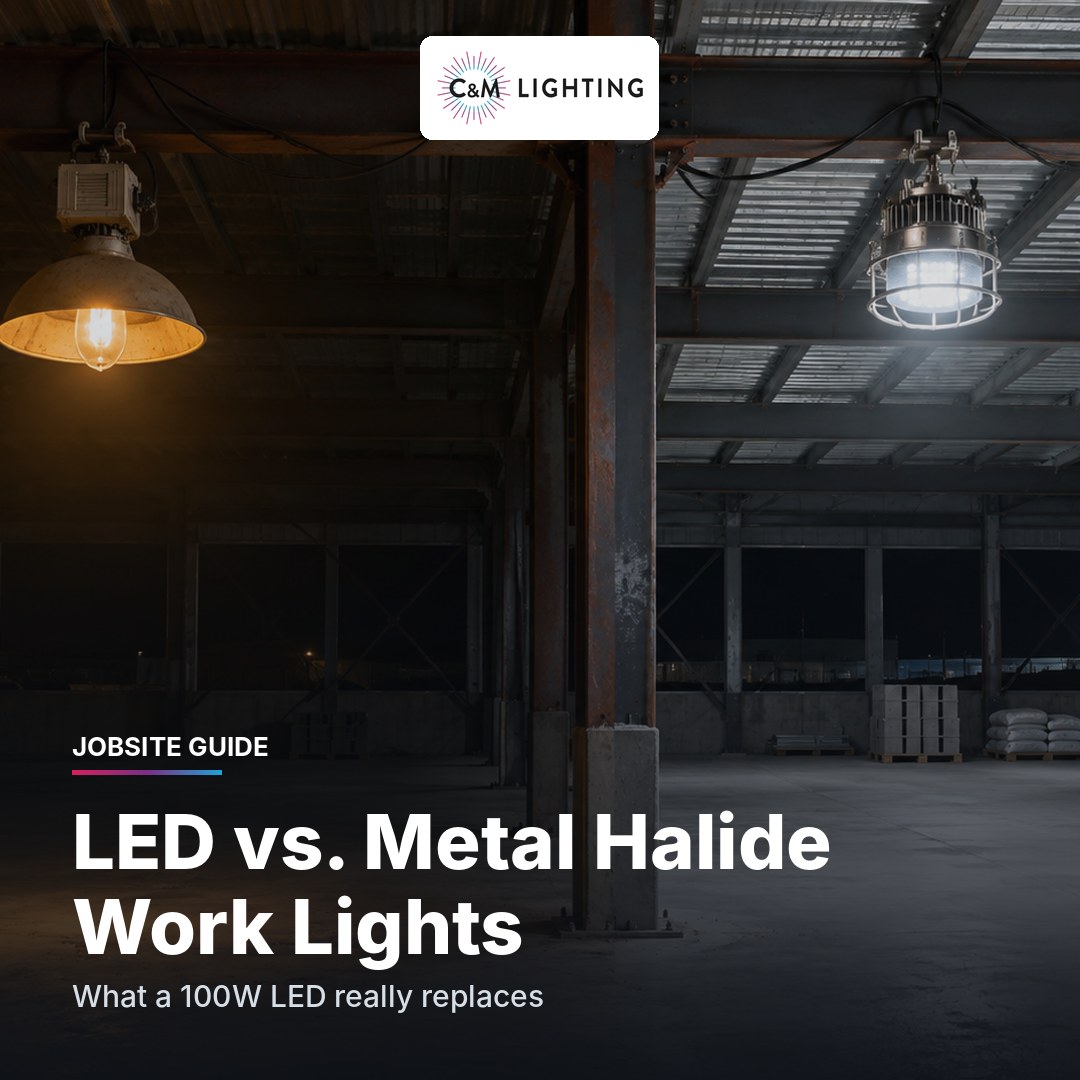
“Replaces 400W HID” is printed on a lot of LED work light boxes. The honest answer depends on how you compare them. Measured against what a metal halide lamp actually delivers over its life, one 100W CM7-100 replaces a 250W metal halide, and two of them replace a 400W, at less than half the power.
Compare mean lumens, not the number on the box
Metal halide lamps lose light fast. Manufacturers publish two figures: initial lumens, when the lamp is new, and mean lumens, measured at 40% of the lamp’s rated life. Mean lumens are the fair comparison, because that’s closer to what a lamp in service puts out on an average day.
250W metal halide
400W metal halide
CM7-100 LED
Power draw
250W lamp plus ballast
458W with a typical ballast
100W
Initial lumens
20,000–22,000
32,000–36,000
14,000
Mean lumens
13,500–17,500
20,500–23,500
14,000 rated; L70 at 50,000 hours
Warm-up to full light
2–4 minutes
2–4 minutes, up to 15 for some lamps
Instant
Restart after a power blip
5–12 minutes
5–20 minutes
Instant
Rated lamp life
10,000–20,000 hours
15,000–20,000 hours
50,000 hours
Metal halide figures are for standard probe-start and pulse-start lamps from Sylvania’s catalog; the range depends on lamp type and burning position.
One CM7-100 lands right in the range of a 250W lamp’s mean output. Two CM7-100s (28,000 lumens, 200W) beat a 400W lamp’s mean output while drawing less than half its 458W.
Where the real savings show up
More light per circuit. A 20-amp circuit should carry no more than 16 amps of continuous load. A 400W metal halide draws about 4 amps at 120V, so a circuit runs about four of them. A CM7-100 draws under 1 amp, so the same circuit runs up to 17, in daisy-chained runs of up to 7. That’s roughly 238,000 lumens per circuit instead of about 90,000.
Lower power bills. Swapping one 400W metal halide for two CM7-100s saves about 258W. Over a 10-hour shift that’s about 2.6 kWh per fixture. At an example rate of 15¢ per kWh and 250 shifts a year, that’s roughly $97 a year for every metal halide you replace.
No waiting in the dark. A tripped breaker or a generator refuel puts metal halide out for 5 to 20 minutes while the lamps cool and restrike. LEDs come back the moment the power does. See our guide to LED work lights in cold weather.
No lamps to replace. A metal halide lamp is a glass arc tube inside a glass bulb, and it wears out in 10,000 to 20,000 hours. The CM7-100 has no lamp to break or swap; its LEDs are rated to keep 70% of their output at 50,000 hours.
Less heat. Nearly everything a fixture draws ends up as heat. A 400W metal halide puts about 458W into the space; two CM7-100s put in 200W.
How to plan the swap
Count your metal halide fixtures by wattage. Plan one CM7-100 for each 250W fixture and two for each 400W.