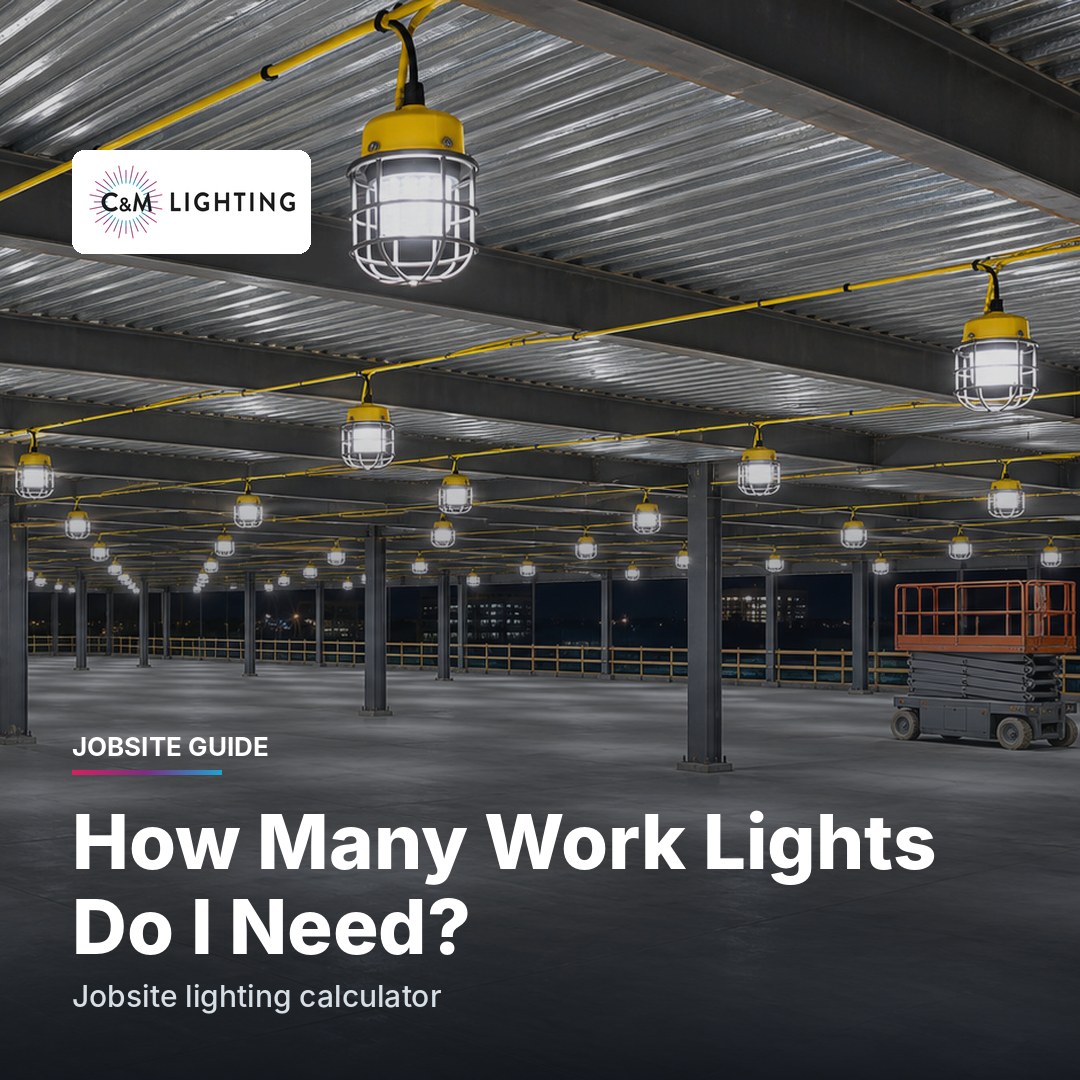
OSHA sets minimum light levels for construction work in foot-candles. Turning that into a number of lights takes one formula. The calculator below does the math for C&M’s CM7-100 work light and SL Series string lights.
Number of lights = (area × foot-candles) ÷ (lumens per light × 0.5). Scroll or tap to load the calculator.
The formula
Lighting designers use the lumen method:
Number of lights = (area in sq ft × foot-candles) ÷ (lumens per light × utilization factor)
Foot-candles is the light level you need. One foot-candle is one lumen spread over one square foot.
Lumens per light is on the spec sheet: 14,000 for the CM7-100.
Utilization factor is the share of a light’s lumens that actually reaches the floor. Some light lands on walls, columns and ceilings, or escapes the space. Finished rooms with light walls can reach 0.6–0.7; an open floor under construction, with dark concrete and no walls, is lower. We default to 0.5 for planning.
As Elliott Electric’s guide to the method notes, it’s “used for estimating purposes only.” Measure with a light meter once the lights are up.
OSHA’s minimum foot-candles
From 29 CFR 1926.56, Table D-3:
Area
Minimum foot-candles
General construction area lighting
5
Indoor corridors, hallways and exitways
5
Accessways, excavation and waste areas, active storage areas
3
Tunnels, shafts and general underground work
5
General construction plant and shops
10
First aid stations, infirmaries and offices
30
These are minimums. Detailed work such as finishing, painting and inspection goes faster and better with more light. See OSHA jobsite lighting requirements.
Worked example
A 100 × 100 ft floor (10,000 sq ft) at 5 foot-candles needs 50,000 lumens at the floor.
Light
Lumens
Usable (× 0.5)
Lights needed
CM7-100
14,000
7,000
8
SL10-100 string (10 lamps)
11,000
5,500
10 strings
At 10 foot-candles for shop work, double it: 15 CM7-100s.
Placing the lights
The count is only half the job. Even coverage matters as much as the total:
Spread lights evenly. One bright corner and one dark corner can average 5 foot-candles and still leave a crew working in the dark.
Mix fixture types. String lights give even general light along corridors and across floors. High-output work lights like the CM7-100 cover open areas and task zones.
Hang high enough to overlap. Higher mounting spreads each light over more floor.
Eight CM7-100s draw about 800W, roughly 7.4A at 120V: one 15A circuit. Keep each daisy chain to 7 lights. For string lights, see LED vs. incandescent bulbs for how many strings fit on a circuit. Running on a generator? See LED work lights on a generator.