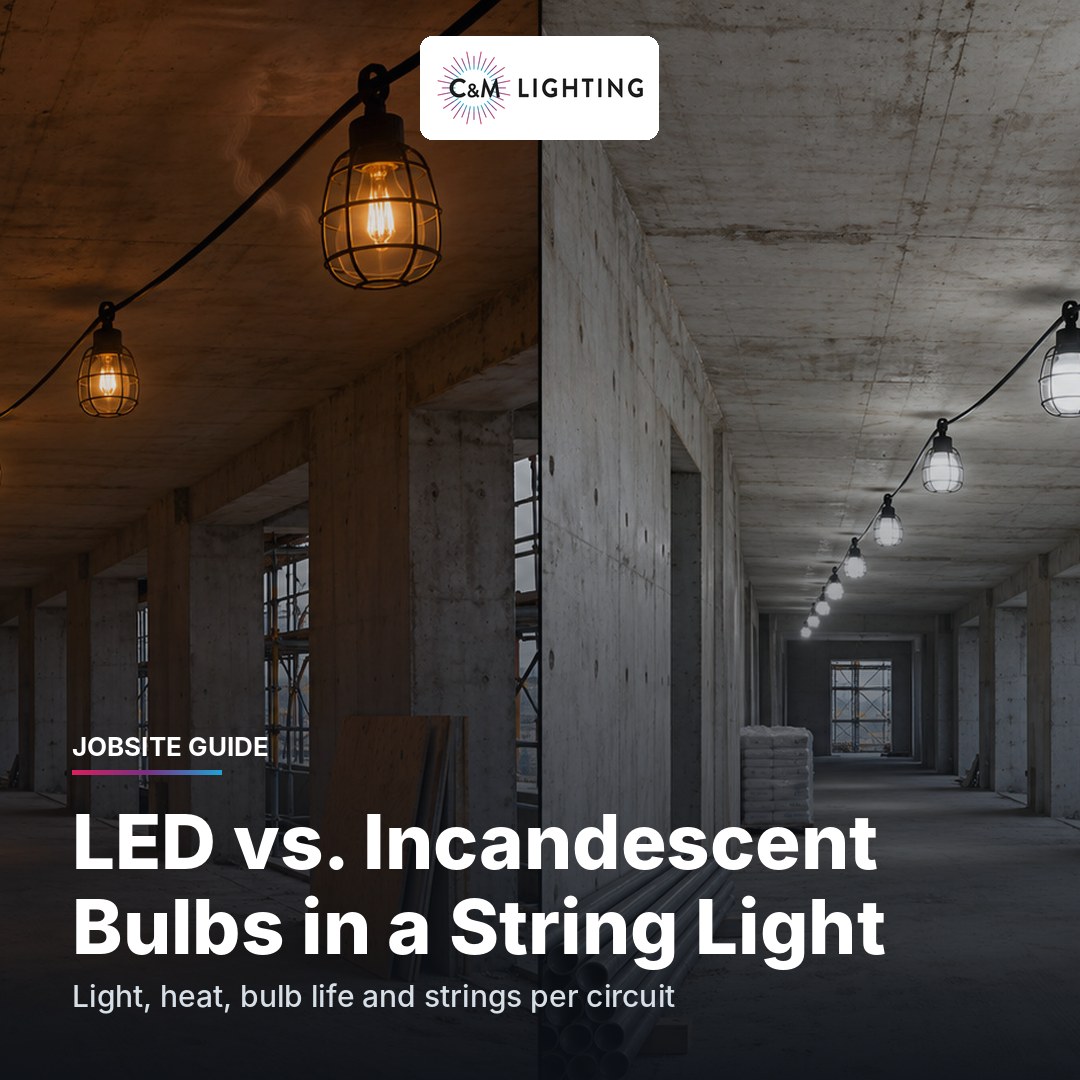
Most temporary string lights take ordinary medium-base (E26) bulbs, so the bulb is your choice. That choice decides how bright the run is, how hot the bulbs get, how often someone climbs a ladder to replace them, and how many strings you can hang on one circuit.
Same light, a fifth of the power
The U.S. Department of Energy matches a 60W incandescent (about 800 lumens) with a 12W LED or a 15W CFL. So a string of ten 12W LEDs gives about the same light as ten 60W incandescents, at a fifth of the power.
Bulb
Watts for ~800 lumens
Rated life (DOE)
Incandescent
60W
1,000 hours
CFL
15W
10,000 hours
LED
12W
25,000 hours
On a jobsite where lights burn around the clock, a 1,000-hour incandescent lasts about six weeks. An LED rated 25,000 hours would outlast the job.
How many strings per circuit
This is where the bulb choice matters most. When strings are linked end to end, the whole run’s current flows through the first string and the circuit breaker. A 15A circuit should carry no more than 12A of continuous load (the 80% rule).
Bulbs in each string (10 per string)
Load per string
Strings per 15A circuit
12W LED
120W (1.0A)
up to 12*
60W incandescent
600W (5.0A)
2
100W incandescent
1,000W (8.3A)
1
150W incandescent
1,500W (12.5A)
0: needs a 20A circuit and a string rated 12.5A
*The circuit allows 12, but voltage drop on a long run usually limits you first. See 12 vs. 14 AWG string lights.
The last row matters for the string itself, too: a 1,500W load is more than the 12A rating of the SL14-2 and SL10-100. Only the SL14-3 and SL12-3 (rated 12.5A, 1,500W) take 150W bulbs in every socket.
With LEDs, one circuit can light many strings, which means fewer cords back to the panel.
Heat
DOE and ENERGY STAR both note that incandescent bulbs give off about 90% of their energy as heat (CFLs about 80%). A hot bulb can scorch insulation, plastic sheeting or anything stacked against it. LEDs run far cooler. For cold-weather work, see winter jobsite lighting.
Cold weather and CFLs
CFLs are cheaper than LEDs to buy but struggle on a cold jobsite. ENERGY STAR notes they take 30 seconds to 3 minutes to warm up and that they’re “sensitive to extreme temperatures.” A Pacific Northwest National Laboratory paper found output can drop on the order of 10–20% when a CFL runs too hot or too cold. Broken CFLs can also release mercury. LEDs start at full brightness in the cold.
Breakage
DOE notes LEDs are “much more resistant to breakage” than glass bulbs. That helps on a jobsite, but it doesn’t replace guards: OSHA 1926.405(a)(2)(ii)(E) requires every lamp to be protected from accidental contact or breakage, whatever the bulb. See OSHA jobsite lighting requirements.
Which string to buy
Want LEDs included? The SL10-100 ships with ten 12W LED lamps and ten snap-on cages, ready to hang.
Bringing your own bulbs? The SL14-2 includes cages and takes LED, CFL or incandescent bulbs.
Running high-wattage bulbs? The SL14-3 and SL12-3 are rated 1,500W.