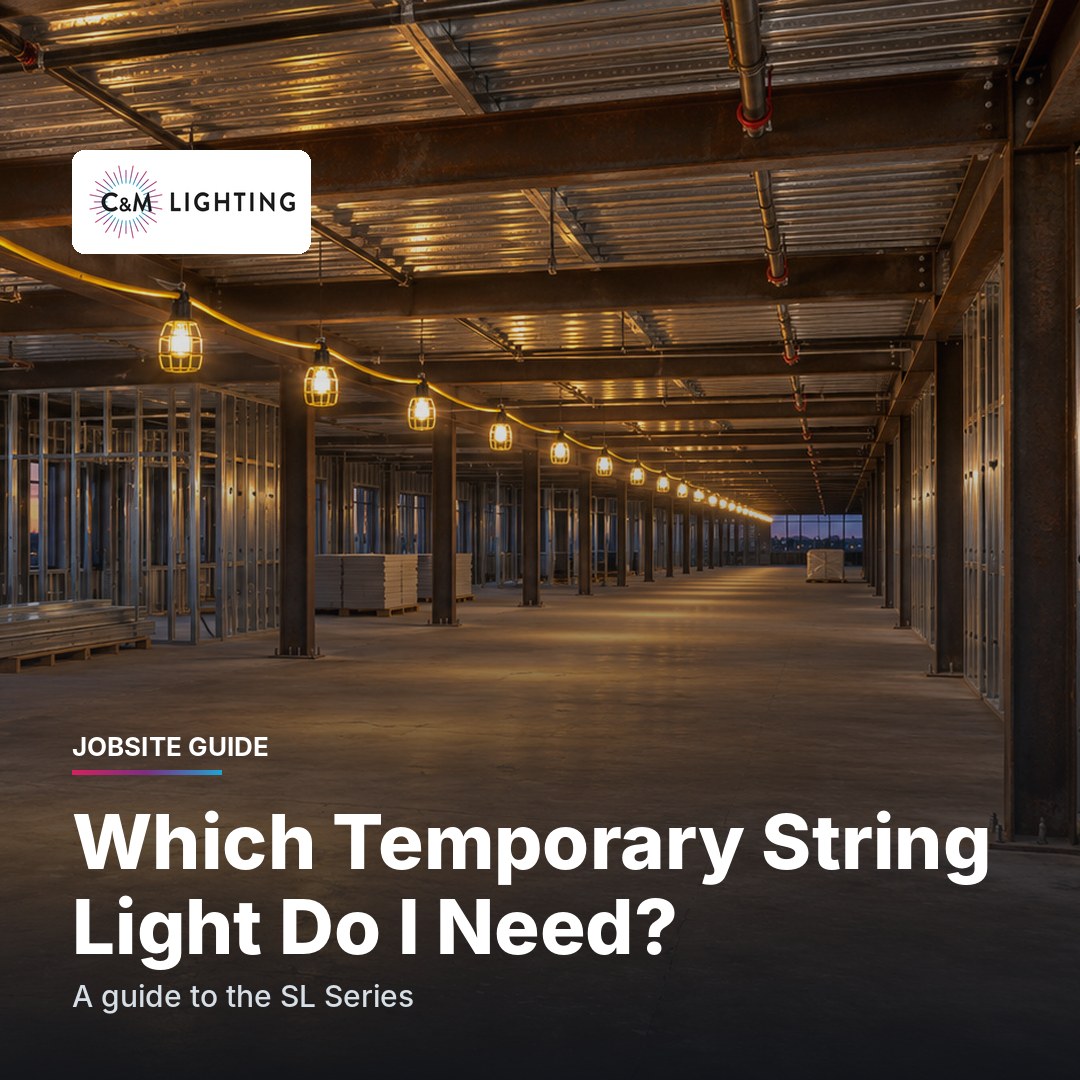
Every construction stringer is a length of cord with lampholders on it, but the differences decide whether it fits your job: whether lamps come in the box, whether the run is grounded, how heavy the cord is and how many strings you can chain. This guide walks through those choices and matches each one to a model in our SL Series.
Every model is 100 ft with ten lights on 10 ft centers. The SL10-100, SL14-2, SL14-3, SL12-3 and SL18-2 LED are ETL listed to UL 1088, the safety standard for temporary lighting strings. If your site or general contractor requires UL 1088-listed temporary lighting, choose one of those five. See UL 1088 explained.
Question 1: Do you want lamps in the box?
Lamps included: the SL10-100 and SL18-2 LED each come with ten 12W, 5000K LED lamps, so they go up straight from the box. The SL10-100 also includes ten snap-on cages. The SL18-2 INT has no bulbs at all: its ten LED heads are built into the string.
Bring your own lamps: the SL14-2, SL14-3 and SL12-3 ship without lamps, so crews can use the LED, CFL or incandescent lamps they already stock, up to 150W per lampholder. Lamp choice changes how many strings you can chain, so see our guide to LED vs. incandescent bulbs in a stringer.
Question 2: Do you need a grounded run?
A /3 cord carries a third conductor, the equipment ground, through the whole run. Some general contractors and job specs require grounded stringers, so check before ordering. The SL14-3 and SL12-3 are the grounded models. The rest are 2-wire.
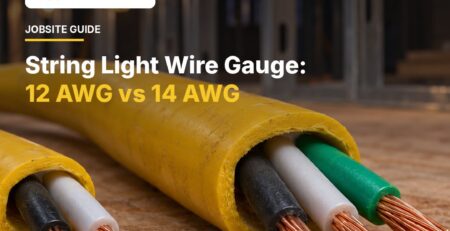
Heavier cord carries more current and loses less voltage over distance. That matters most on long chains, where the first string carries the load of every string after it.
18 AWG (SL18-2 LED, SL18-2 INT): light-duty LED runs. The SL18-2 LED is limited to 12W lamps.
14 AWG (SL10-100, SL14-2, SL14-3): the usual choice for typical floors and corridors.
12 AWG (SL12-3): long chains across big floors and heavy-duty sites.
Every SL model has a plug on one end and a connector on the other, so runs chain end to end. The limit is the string’s rating, which covers every string connected to it. With 12W LED lamps, a string draws about 1 amp, so a 12A string leaves plenty of room. With 100W incandescent lamps, a single string draws more than 8 amps, so you can’t add a second.
The SL18-2 INT can link up to 4 strings. Past that, voltage drop dims the far end and the cord can overload, so start a new run from another outlet.