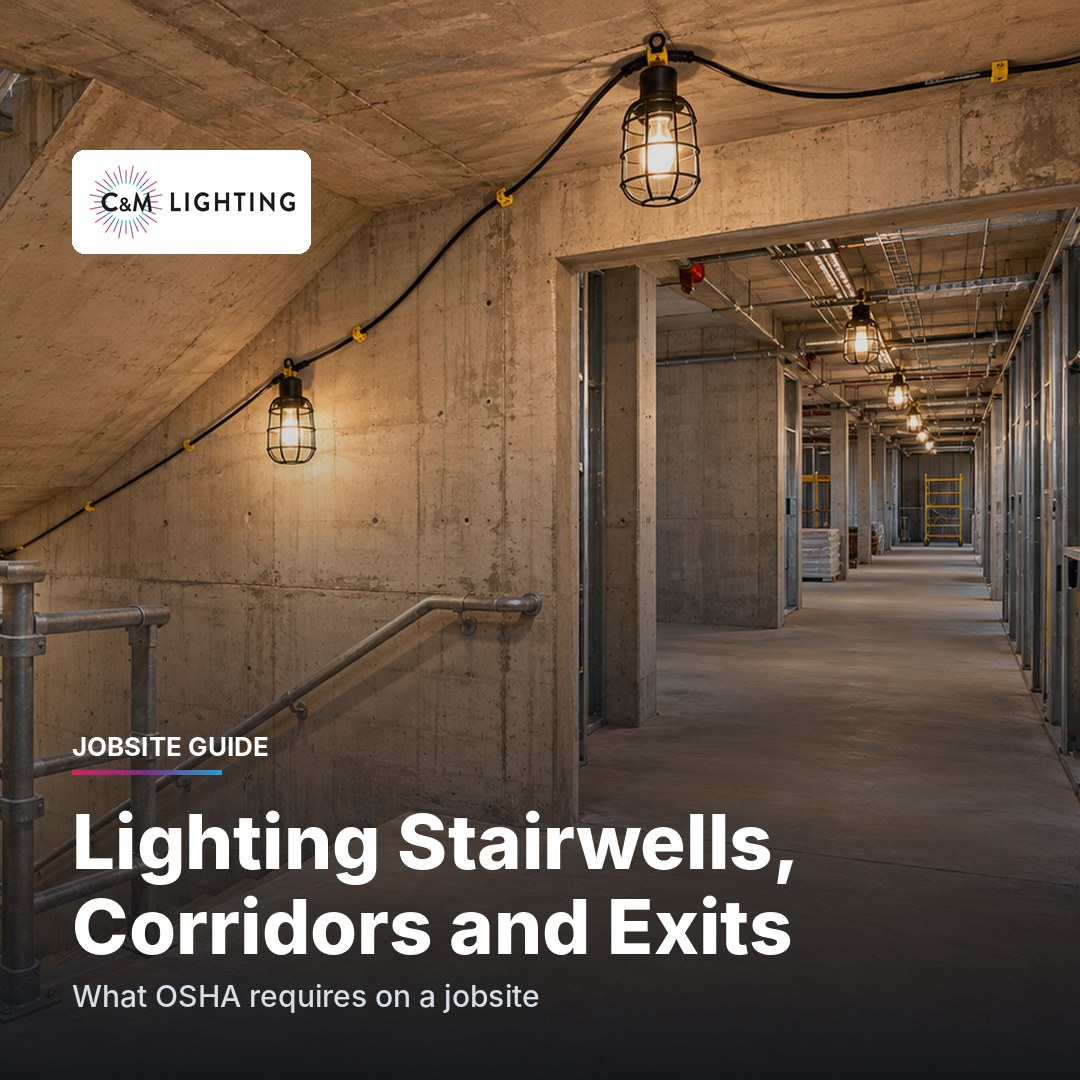
Stairwells and corridors are where crews move between floors, carry material and get out in an emergency. In a building under construction, they’re also often the darkest spaces on the site. Here’s what OSHA requires and how to light them.
What OSHA requires
Stairs must be lit. 29 CFR 1926.26 says “construction areas, aisles, stairs, ramps, runways, corridors, offices, shops, and storage areas where work is in progress shall be lighted with either natural or artificial illumination.”
How bright. The minimums are in Table D-3 of 29 CFR 1926.56, in foot-candles:
Area
Minimum foot-candles
Indoor corridors, hallways and exitways
5
General construction area lighting
5
Accessways, excavation and waste areas, active storage areas
3
Tunnels, shafts and general underground work
5
The table has no row just for stairways. Since a stairwell is part of the route between floors, lighting it to at least the 5 foot-candles required for indoor corridors and exitways is a sensible target.
Exits must stay usable. 29 CFR 1926.34 requires exits to be marked by a readily visible sign and kept “free of all obstructions or impediments to full instant use in the case of fire or other emergency.”
Your local fire code and NFPA 241 (fire safety during construction) may add stair lighting and signage rules. Check with your fire marshal or AHJ.
Why it matters
OSHA has long named stairways and ladders as “major sources of injuries and fatalities among construction workers.” Its construction pocket guide estimated about 24,882 injuries and up to 36 deaths a year from falls on stairways and ladders, with nearly half serious enough to require time off the job.
Rules for the temporary lights themselves
From 29 CFR 1926.405(a)(2)(ii):
Guard every lamp against accidental contact or breakage, (E). Stairwells are tight, and a ladder or a length of pipe swings easily into an unguarded bulb.
Don’t hang lights by their cords unless they’re designed for it, (F). Use hooks, ties or hangers.
Keep lighting circuits for lighting. No receptacles for other uses on temporary lighting branch circuits, (C). Don’t let crews plug tools into the string.
A 100 ft string with sockets every 10 feet suits stairwells well: run it up the stair shaft and you get a light at roughly every landing and mid-flight.
Put a light at every landing and the top and bottom of each flight, where people change direction and miss steps.
Hang the string along the wall or ceiling, out of the walking path, so cord and lamps don’t catch shoulders, ladders or material being carried.
Keep cord off the treads. Run it up the shaft, not along the steps.
Light the corridors to the stairs too. Exit routes need light the whole way out.
Check with a light meter. Foot-candles at the treads and floor are what count, not bulb wattage.
Plan for power loss. If one circuit feeds the whole stair, a tripped breaker leaves crews in the dark mid-climb. Consider splitting long stair runs between circuits and keeping flashlights at landings.
Which string to use
Pick a string that is ETL listed to UL 1088 and comes with lamp guards:
SL10-100: ten 12W LED lamps and ten snap-on cages included. Ready to hang.