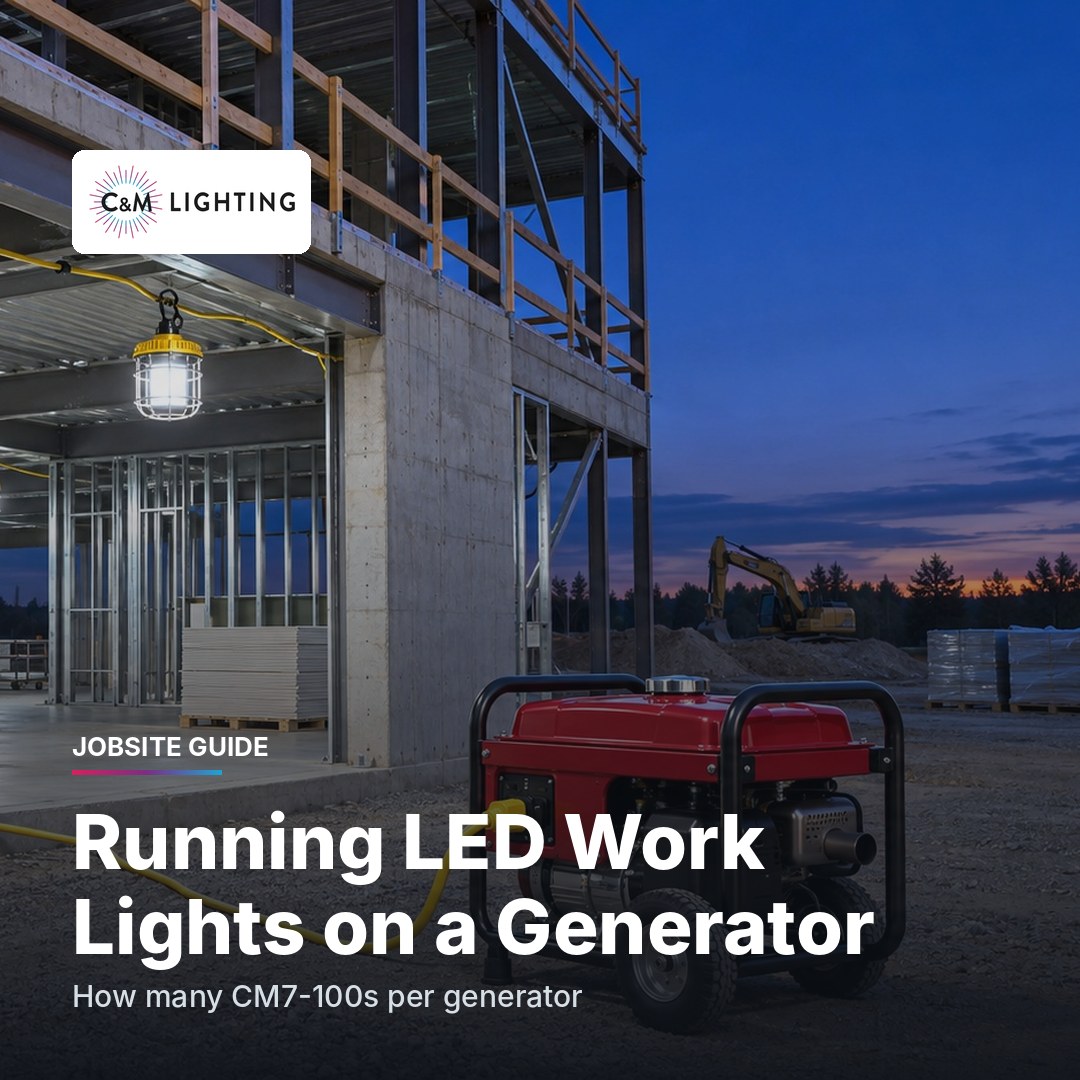
Not every jobsite has power on day one. When the lights run off a portable generator, LED work lights stretch the fuel and the generator’s capacity much further than the metal halide lights they replace. Here’s how to size a generator for the CM7-100 and set it up safely.
How much power one CM7-100 draws
Spec
CM7-100
Power
100W
Light output
14,000 lumens
Power factor
above 0.9
Draw at 120V
about 0.9A (under 1A)
Plug
NEMA 5-15 (120V)
At a power factor above 0.9, each light needs no more than about 111 volt-amps (VA) from the generator: 100W ÷ 0.9. That’s the number to use for sizing, since a generator’s capacity is limited by current as well as watts.
The CM7-100 accepts 120–277V, but it ships with a standard NEMA 5-15 plug, so on a portable generator you’ll run it from the 120V outlets.
How many lights per generator?
Use the generator’s running (rated) watts, not its peak or starting watts, and leave some headroom: plan on loading it to about 80%.
Lights per generator ≈ running watts × 0.8 ÷ 111
Generator running watts
CM7-100s (at ~80% load)
2,000W
about 14
3,000W
about 21
5,000W
about 36
Two more limits apply:
Each outlet circuit. Check the generator’s receptacle ratings. A 20A, 120V outlet handles about 17 lights at 80% of its rating; a 15A outlet about 12. Spread lights across outlets if you need more.
Each daisy chain. The CM7-100’s 10 ft 18/3 cord and connector let you link lights end to end. Keep a chain to 7 lights or fewer: about 6.5A at 120V, within the cord’s rating.
Compare that with metal halide: a 400W metal halide draws about 458W with its ballast, and it takes two CM7-100s (200W) to match its light. See CM7-100 vs. metal halide. On the same generator you can run more than twice as much light with LEDs.
Inverter or conventional generator?
Generators differ in how “clean” their power is, measured as total harmonic distortion (THD):
Generac says conventional portable generators typically run 9–15% THD, some as high as about 30%.
Its inverter generators produce 3% or less.
Generac considers under 6% “clean power” and warns that higher THD can shorten the life of sensitive electronics.
LED work lights use electronic drivers. If you have a choice, an inverter generator gives the cleanest power. If lights flicker or behave oddly on a conventional generator, try an inverter unit or check the generator’s voltage and frequency.
LEDs have one big advantage on generators: they start at full brightness instantly. If the generator stalls or runs out of fuel, the lights come right back on restart. Metal halide lamps need to cool before they restrike, which can leave a crew in the dark for several minutes.
Generator safety on a jobsite
GFCI protection
OSHA 29 CFR 1926.404(b)(1)(ii) requires GFCI protection for 120V, single-phase, 15- and 20-amp receptacle outlets on construction sites that aren’t part of the building’s permanent wiring. That includes generator outlets. The exception is narrow: a two-wire, single-phase portable or vehicle-mounted generator rated 5 kW or less whose circuit conductors are insulated from the frame. Many modern generators have GFCI outlets built in. If yours doesn’t, plug into a portable GFCI.
Grounding
OSHA’s fact sheet on portable generators says the generator’s frame can serve as the ground, with no driven ground rod, when the generator supplies only equipment plugged into its own receptacles and those receptacles’ grounding terminals are bonded to the frame. A generator feeding a building through a transfer switch must be connected to a grounding electrode system.
Lighting rules still apply
The OSHA rules for temporary lighting apply whatever the power source: guard every lamp (the CM7-100’s stainless-steel cage does that), don’t hang lights by their cords unless designed for it, and keep lighting circuits for lighting. See OSHA jobsite lighting requirements.
Carbon monoxide
Never run a generator indoors or in an enclosed space. Place it outside, away from doors, windows and air intakes.
Cold-weather generator lighting
The CM7-100 is rated to run from −22°F to 140°F, so it works on winter sites where generator power is common. See LED work lights in cold weather.
Lighting a site from a generator? See the CM7-100, or contact us for volume pricing.