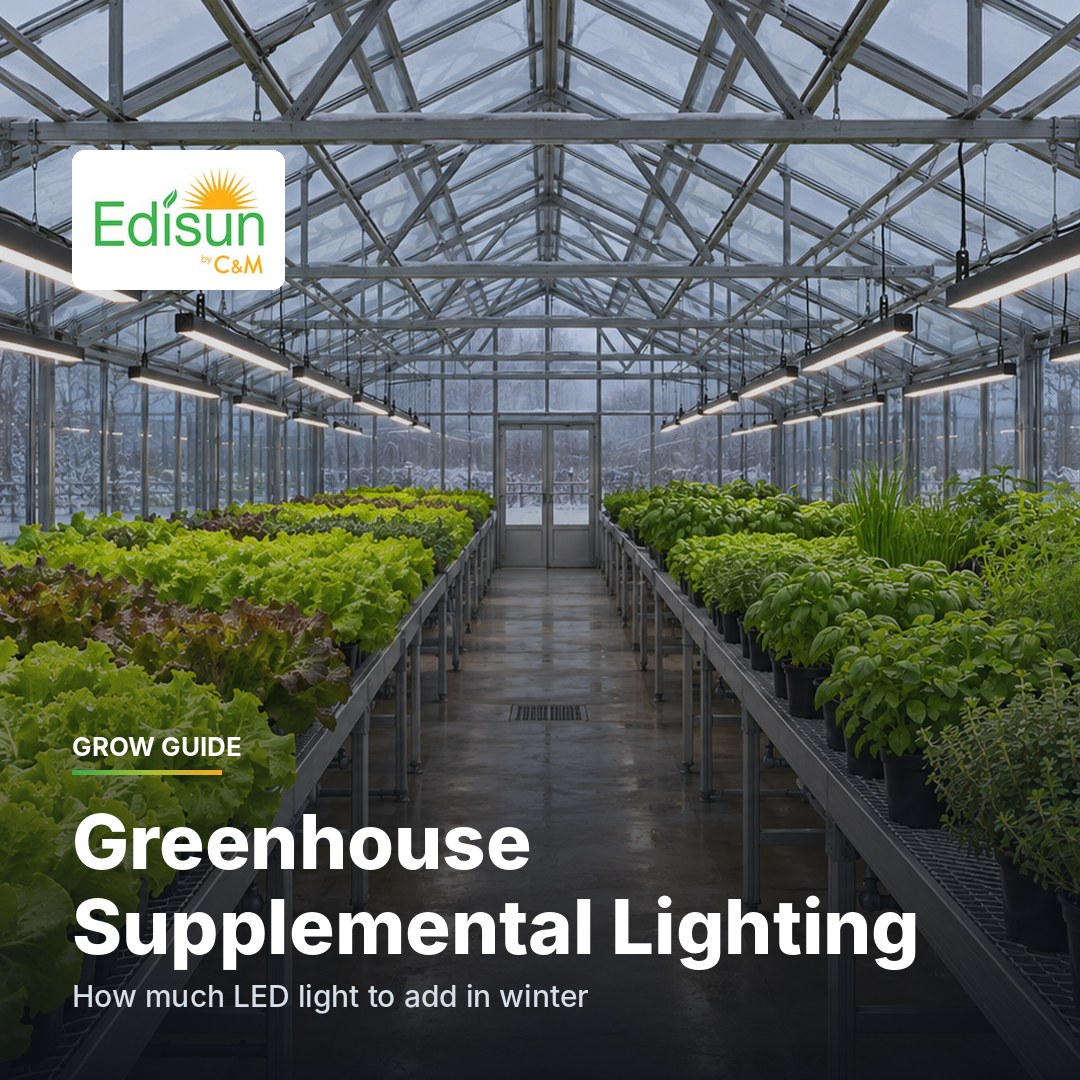
A greenhouse that grows well in June can starve its crops in December. Short days, low sun and cloudy weeks cut the light reaching the bench to a fraction of what most crops need. Supplemental lighting closes that gap, and LEDs have made it far cheaper to run. Here’s how to work out how much light to add, and what to look for in a greenhouse fixture.
How dark a winter greenhouse really gets
Growers measure a day’s light as the daily light integral (DLI): the total light a crop receives in a day, in moles per square meter (mol/m²/day).
Most crops need 10–12 mol/m²/day. Michigan State University researchers cite an average of at least 10–12 for most ornamental crops, and vegetable crops often need more.
Winter greenhouses fall far short. Glazing, the structure and hanging baskets can cut outdoor light by 40–70%, according to Purdue Extension. In MSU’s research greenhouses in late December, DLI averaged only about 2–4 mol/m²/day.
Low light costs time. In MSU trials, young plants grown below 10 mol/m²/day had fewer roots and stretched stems, and could take up to twice as long to be ready to transplant.
How much light to add
Start with the gap between what your crop needs and what the greenhouse gives it, then work out how long your lights need to run to fill it.
PPFD is the light your fixtures deliver to the canopy, in µmol/m²/s. The 0.0036 converts it to moles per hour.
Natural DLI
Target DLI
Gap
Hours at 150 PPFD
Hours at 200 PPFD
4 (cloudy December)
12
8
15
11
6
12
6
11
8
8
12
4
7
6
A higher PPFD fills the gap in fewer hours. A lower PPFD over more hours needs fewer fixtures. Both give the crop the same total light.
Why linear bars suit greenhouse top-lighting
In a greenhouse, anything hung over the crop also blocks some of the sun. That’s the main reason growers use slim linear fixtures for top-lighting.
A narrow bar casts a narrow shadow. Our Edisun FXL Series bars are 2.9″ wide, so they block very little sunlight on bright days.
They run in rows. Linear bars line up over benches and gutters, and spacing them evenly gives even light down the row.
They handle greenhouse humidity. The FXL is rated IP66 and passively cooled, with no fans to clog or corrode. See our guide to what IP ratings mean.
Run lights only when the crop needs them
Supplemental light pays off when the sun isn’t providing enough, and there’s little benefit to running it on bright days. MSU recommends controlling lights with an environmental control system or a light sensor rather than a simple timer.
LEDs make that easy. They switch on and off instantly, with no warm-up or restrike, so a controller can turn them on when a cloud passes and off when it clears. Some growers go further and dim their lights as sunlight rises, holding the canopy at a steady light level. Every Edisun fixture dims down to 10%, so you can supplement by season, crop stage or the weather instead of running full power all day.
Sizing a greenhouse bench
A quick estimate of the average light from a fixture:
Average PPFD ≈ PPF × 0.75 ÷ area lit in m²
Fixture
PPF (at 277V)
Area for about 200 PPFD
FXL-320
850 µmol/s
About 32 sq ft (for example, 4 × 8 ft)
FXL-600
1,608 µmol/s
About 64 sq ft (for example, 8 × 8 ft)
The 0.75 is a planning rule of thumb. Mounting height, spacing and the greenhouse structure all change how much light reaches the canopy, so confirm with a PAR meter once the lights are up. Mount FXL fixtures at least 12″ above the canopy.
For larger ranges with heavier output needs, the Edisun Burst Series foldable bars mount to standard greenhouse infrastructure too.
Planning checklist
Know your target DLI for each crop and stage.
Measure or estimate your natural DLI through the darkest months.
Work out the gap and the hours of supplemental light needed to fill it.
Choose slim fixtures that shade the crop as little as possible.
Control lights by sunlight, not just a timer, and dim when the sun is doing part of the work.
Keep glazing clean. Dirty glazing cuts the free light you’re paying to replace.