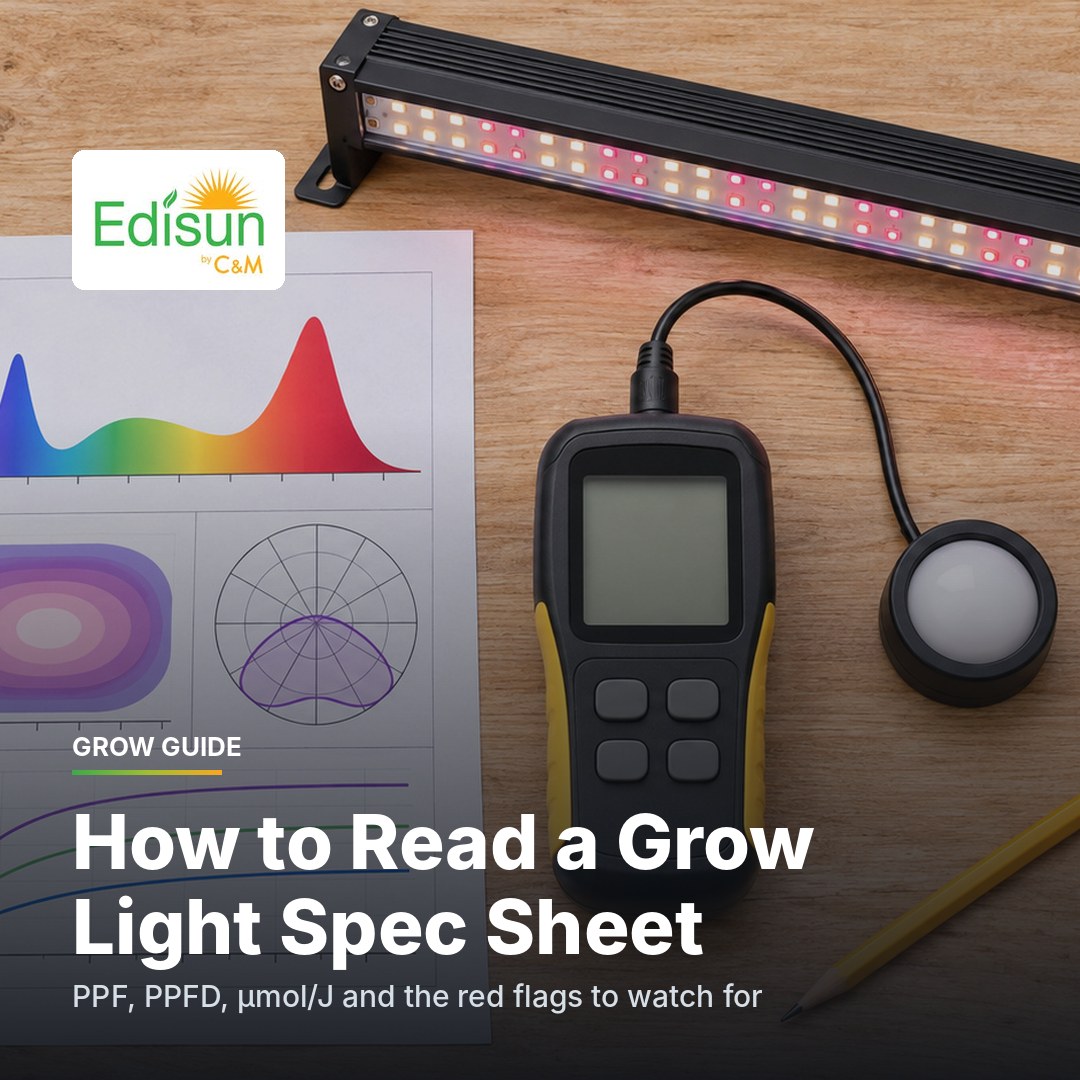
Watts tell you what a grow light costs to run. They don’t tell you how much light it makes. To compare fixtures, you need three numbers from the spec sheet: PPF, µmol/J and a PPFD map. Here’s what each means, using our FXL-320 spec sheet as the example.
The three numbers that matter
Term
What it measures
Unit
FXL-320
PPF (photosynthetic photon flux)
Total usable light the fixture puts out each second
µmol/s
850 µmol/s @ 277V
µmol/J (efficacy, also called PPE)
Light out per watt in. The single best measure of efficiency
µmol/J
2.63 µmol/J @ 277V
PPFD (photosynthetic photon flux density)
Light landing on one spot of the canopy each second
µmol/m²/s
Depends on hang height and area
Think of PPF as the size of the hose, µmol/J as how little water pressure it takes, and PPFD as how wet one patch of lawn gets.
Check the math. PPF ÷ watts should roughly equal the efficacy. For the FXL-320: 850 ÷ 320 = 2.66 µmol/J, in line with its rated 2.63. When a spec sheet’s numbers don’t agree with each other, ask why.
What does µmol/m²/s mean?
It’s the unit of PPFD: how many micromoles of usable light land on one square meter of canopy each second. Leafy greens do well at about 140–245 µmol/m²/s over a 16-hour day, and fruiting crops want 350–520 or more. See the crop table in our grow light rack setup guide.
Is there a PPF meter?
Not a handheld one. PPF is measured in a lab with an integrating sphere and printed on the spec sheet. A quantum (PAR) meter measures PPFD at one spot, which is how you check a fixture’s PPFD map at your own hang height.
Why a single PPFD number isn’t enough
PPFD changes across the footprint. It’s highest directly under the fixture and falls off toward the edges. A sheet that lists one big PPFD figure is almost always quoting the center.
Ask for, or look for, a PPFD map: a grid of readings across the whole footprint at a stated hang height. Then compare:
Average PPFD across the grid, which tells you what most of your plants get.
Corner readings, which tell you what your weakest plants get.
Uniformity, the minimum divided by the average. Closer to 1.0 is more even.
A fixture can post an impressive center number and still leave the corners underlit.
The rest of the sheet
Spec
What to look for
FXL-320
Input voltage
Whether it runs on your circuits; efficacy is often quoted at the highest voltage
100–277V, PF > 0.97
Rated life
Hours of use the maker stands behind
50,000 hours
Light source
Named LED maker and package
Lumileds 3030
Spectrum chart
Shape of the light across 380–800 nm
Full-spectrum chart on sheet
Beam angle
How widely light spreads
120°
Recommended hang height
Minimum distance above the canopy
At least 12″
Dimming
How low it goes, and how
Down to 10%
IP rating
Protection from dust and water
IP66
Certifications
Electrical safety (UL or ETL) and efficiency (DLC)
ETL, DLC
Warranty
Length and who backs it
5 years
Red flags
“Equivalent” wattage only. “Replaces a 1000W HPS” says nothing measurable.
Lumens or lux instead of PPF. Those measure light for human eyes, not plants.
No PPF or µmol/J anywhere. If a fixture lists only PPFD, you can’t compare its total output or efficiency.
Efficacy without a voltage. Many fixtures are a little less efficient at 120V than at 277V. Ask for the figure at the voltage you’ll run.
A DLC claim the seller can’t back up. Ask for the DLC listing documentation. A reputable seller will send it.