If you searched for “UL 1088,” you were probably looking for the standard itself, or trying to work out whether the string lights on your jobsite meet it. The standard isn’t a free download: UL Standards & Engagement sells it, along with standards resellers. What most contractors need isn’t the full text anyway. They need to know what UL 1088 covers, why it matters to OSHA, and how to check a stringer before it goes up. That’s what this guide covers.
What is UL 1088?
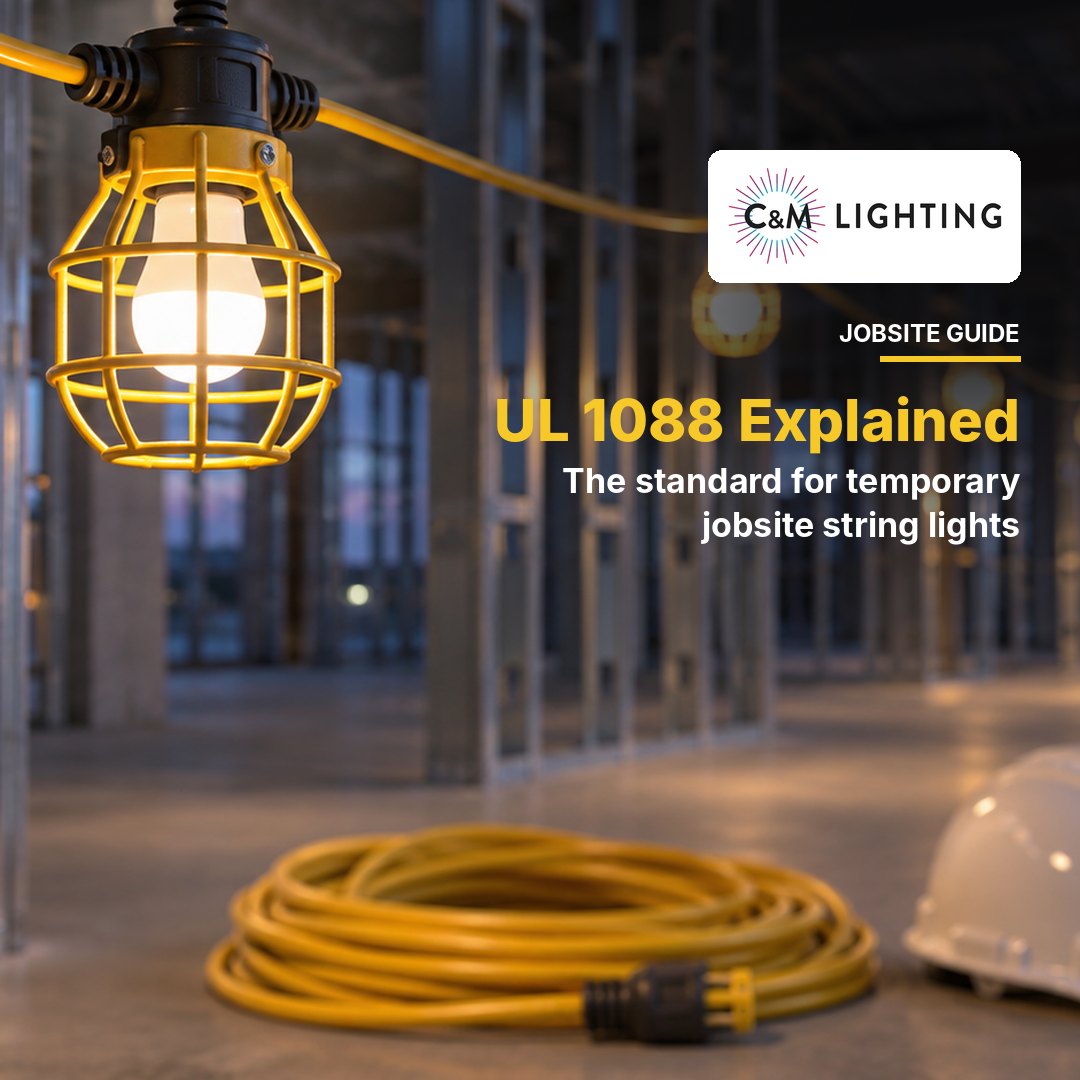
UL 1088 is the Standard for Temporary Lighting Strings: the safety standard for the construction string lights (stringers) that light a site while the permanent lighting isn’t in yet. The current edition is the 7th, dated July 10, 2015. It’s a joint US–Canada standard, published in Canada as CAN/ULC-S1088.
In plain terms, it covers:
- What the product is: a factory-built length of flexible cord with at least two light sources. Those are either sealed, non-replaceable LEDs, or lampholders (sockets) fitted with lamp guards.
- What it’s for: temporary lighting, indoors or outdoors, during construction, remodeling, maintenance, repair or demolition.
- Its electrical limits: 125 volts, and no more than 20 amps, counting every string you’re allowed to link together. The rating also can’t exceed what the cord itself can carry.
Temporary lighting strings are tested for the kind of abuse they get on a jobsite: being dragged, stepped on, rained on and hung from studs. That’s the difference between a stringer and string lights that only look similar.
What UL 1088 doesn’t cover
Two other standards cover lights that look a lot like stringers:
- UL 153 (portable luminaires): general-use string lights for task or ambient lighting, like patio and café lights. These aren’t evaluated for temporary installations under NEC Article 590, which is where jobsite lighting falls.
- UL 588 (seasonal and holiday decorative products): holiday lights, decorative strings, and any lighting string with cord thinner than 18 AWG.
A listing mark only tells you a product passed some standard. For a stringer on a construction site, you want it listed as a temporary lighting string, to UL 1088.
Why it matters on an OSHA jobsite
OSHA’s construction electrical rules (29 CFR 1926 Subpart K) don’t name UL 1088. What they do say is that all electrical conductors and equipment must be approved (1926.403(a)). Under the definitions in 1926.449, OSHA accepts equipment that a qualified testing laboratory has listed, labeled or otherwise found safe. In practice, that means a Nationally Recognized Testing Laboratory, or NRTL. A stringer listed to UL 1088 by an NRTL is the straightforward way to meet that rule.
The temporary-wiring rules in 1926.405(a)(2)(ii) then set out how the lights are used:
- (E) All lamps for general illumination must be protected from accidental contact or breakage, and metal-case sockets must be grounded. On stringers, that’s what the cages or guards are for.
- (F) Temporary lights can’t be hung by their cords unless the cord and lights are designed for it. Use the hooks or hangers.
- (J) Cords used with temporary and portable lights must be designed for hard or extra-hard usage. SJTW, the cord most stringers use, is a hard-usage type.
For lighting levels and the rest of the jobsite rules, see our guide to OSHA jobsite lighting requirements.
UL listed vs. ETL listed: is there a difference?
UL writes the standard, but UL isn’t the only lab allowed to test to it. OSHA recognizes several NRTLs, including UL, Intertek (whose mark is ETL), CSA and others. Each one can certify products to the standards in its OSHA-recognized scope.
So “ETL listed to UL 1088” means Intertek tested the stringer to the UL 1088 requirements and keeps checking production. NRTLs recognized for the same standard are considered equivalent in their ability to test and certify to it. For the jobsite, what matters is a recognized lab’s mark and the right standard, not which lab’s logo is on the tag. A mark with both “C” and “US” (cETLus, cULus) means the product is listed for Canada as well as the US.
How to check a stringer before it goes up
- Find the listing mark. It’s usually on a tag near the plug or printed on the packaging. Look for a recognized lab’s mark (UL, ETL, CSA and so on) with the “US” identifier.
- Check what it’s listed as. The listing or spec sheet should name temporary lighting strings or UL 1088, not portable luminaires or decorative lighting. If in doubt, look the model up in the lab’s online certification directory.
- Read the rating label. Note the amp and watt rating and the maximum number of strings you can link end to end. Linking more than that is how runs overload. Our wire gauge guide explains how cord size affects run length.
- Check the guards. Every socket needs a cage or guard, or the light source must be a sealed, built-in LED.
- Check the cord. Look for a hard-usage type such as SJTW, printed on the jacket, with no cuts, crushed spots or taped repairs.
- Hang it properly. Use the built-in hooks or hangers, keep it clear of sharp edges and pinch points, and plug it into GFCI-protected power.
C&M SL Series stringers listed to UL 1088
These C&M Lighting stringers are ETL listed to UL 1088:
- SL10-100: 100 ft of 14/2 SJTW with caged sockets and 10 LED lamps included
- SL14-2: 100 ft of 14/2 SJTW with caged sockets, no lamps
- SL14-3: 100 ft of grounded 14/3 SJTW with caged sockets, no lamps
- SL12-3: 100 ft of heavy-duty, grounded 12/3 SJTW with caged sockets, no lamps
- SL18-2 LED: 100 ft of 18/2 SJTW with 10 LED lamps included
Need a listing document for a GC or an inspector, or help picking the right stringer? Contact us.
UL 1088 FAQ
Can I download UL 1088 for free?
No. UL 1088 is a copyrighted standard sold by UL Standards & Engagement and authorized standards resellers. To check a product, you don’t need the standard: look for the listing mark and confirm the listing in the testing lab’s directory.
Does OSHA require UL 1088?
OSHA doesn’t name the standard. It requires electrical equipment on a construction site to be approved, which in practice means listed by a recognized testing lab. For temporary lighting strings, UL 1088 is the standard those labs test to.
Is ETL listed as good as UL listed?
For the same standard, yes. Intertek (ETL) and UL are both OSHA-recognized NRTLs, and either can list a stringer to UL 1088.
Are patio or holiday string lights okay on a jobsite?
They’re usually listed to UL 153 or UL 588, not UL 1088. Those standards don’t evaluate the product for temporary construction lighting, so use a stringer listed as a temporary lighting string.
This guide is general information, not legal or code advice. Requirements can vary by state plan and local authority having jurisdiction; check with your safety officer or inspector for your site.