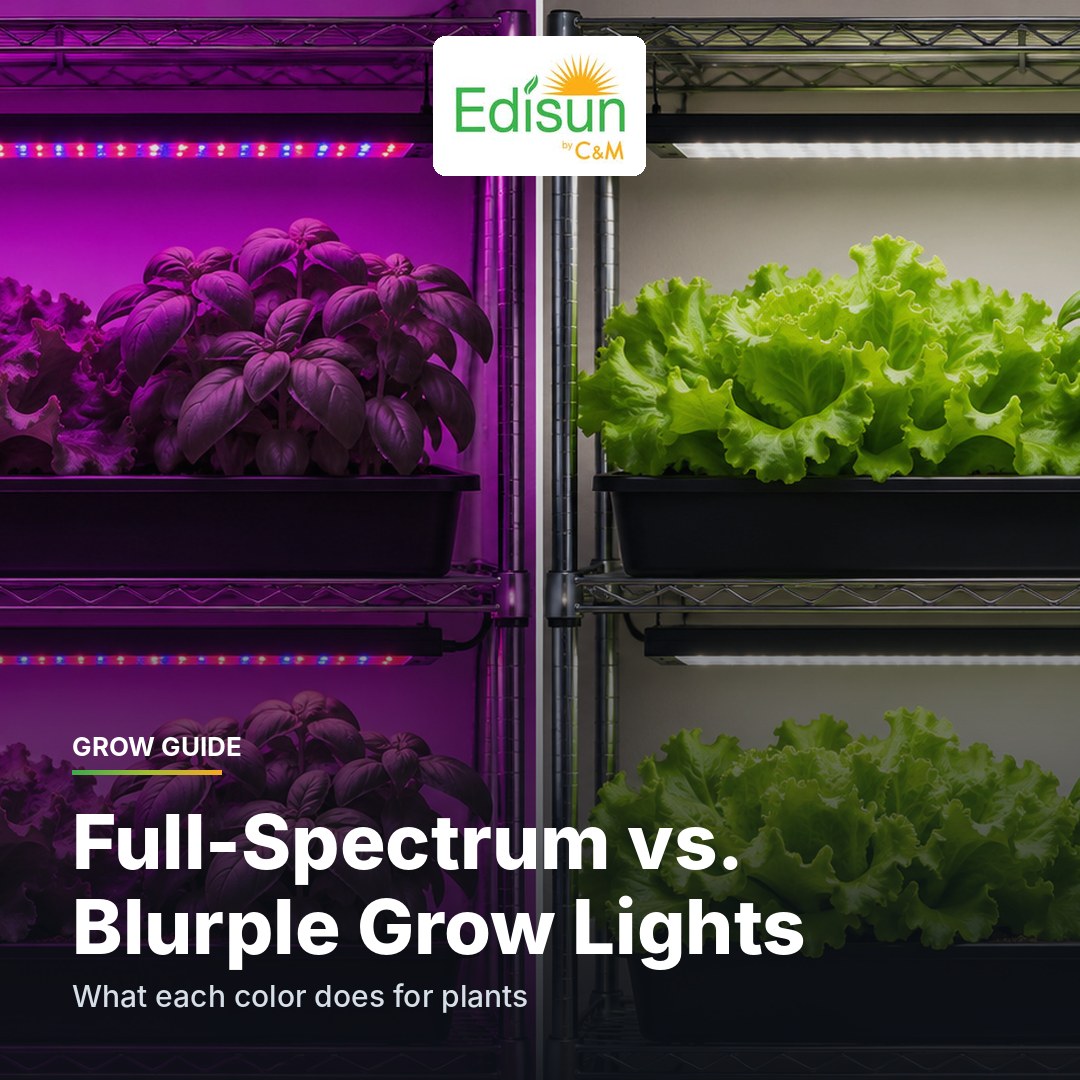
Early LED grow lights glowed purple. Today most glow white. Both can grow good plants. Here’s why the two exist and how to choose.
Why grow lights were purple
Plants use red and blue light efficiently, and red and blue LED chips are the most efficient chips made. Research by Kusuma, Pattison and Bugbee (2020) gives typical chip efficiencies:
LED chip
Efficacy (µmol/J)
Red
about 4.5
Blue
about 3.5
White (phosphor)
about 2.9
So a red/blue mix squeezed out the most light per watt. Mixed together, red and blue look purple: “blurple.”
Why most growers moved to white
White LEDs have closed much of the gap, and white light has practical advantages:
You can see your plants. Under purple light, healthy leaves look gray-black and problems like yellowing, pests or mold are hard to spot. Kusuma and colleagues note white light makes plants easier to inspect and is more comfortable to work under.
Green light isn’t wasted. Plants reflect some green, which is why they look green, but MSU’s Erik Runkle explains that green light penetrates deeper into the canopy than red or blue, reaching lower leaves that would otherwise be shaded.
It’s easier on the eyes during long hours of work.
White isn’t automatically better for photosynthesis, though. Kusuma’s review found broad spectrum isn’t necessarily more productive than a well-designed red/blue mix. The advantages are mostly about working with the crop.
What each color does
Runkle’s summary of the main wavebands:
Color
Wavelength
What it does
Blue
400–500 nm
Drives photosynthesis; keeps plants compact; promotes color
Green
500–600 nm
Drives photosynthesis; reaches lower leaves
Red
600–700 nm
The most efficient driver of photosynthesis
Far-red
700–750 nm
Works with red and blue to boost growth; stretches stems and expands leaves
Far-red sits just past what most light meters count, but it matters. Zhen and Bugbee (2020) found that adding far-red to the light increased lettuce biomass by about 29–31%.
How to choose
Red/blue (“blurple”)
Full-spectrum white
Light per watt
Can be very high
Slightly lower per chip; modern fixtures close the gap
Seeing plant health
Hard
Easy
Working under it
Uncomfortable
Comfortable
Best for
Unattended production rooms
Anywhere people work with or inspect the crop
The more useful question isn’t the color. It’s how much usable light the fixture makes per watt (µmol/J) and how evenly it covers your space. Those numbers are on the spec sheet. See how to read a grow light spec sheet.
What to look for on the spec sheet
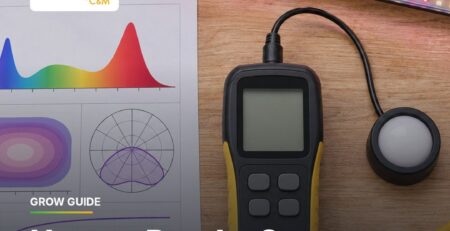
A spectrum chart showing output across 400–750 nm, not just “full spectrum” in the product name.