Grow light spec sheets use two numbers that look almost the same: PPF and PPFD. They measure different things, and mixing them up is the easiest way to buy the wrong light.
The short version
PPF (photosynthetic photon flux) is how much plant-usable light a fixture makes, in micromoles per second (µmol/s). It’s a property of the light.
PPFD (photosynthetic photon flux density) is how much of that light lands on a square meter of your plants each second (µmol/m²/s). It depends on the light and on how you hang it.
Michigan State’s Erik Runkle offers a simple test: look at the unit. If it includes m², it’s describing intensity at a surface (PPFD). If not, it’s the fixture’s total output (PPF).
Think of a garden hose. PPF is how much water comes out of the nozzle. PPFD is how much lands on each square foot of lawn, which depends on how high you hold the hose and how wide you spray.
Why both matter
PPF tells you what you’re buying. It’s measured in a lab with an integrating sphere that captures every photon the fixture emits, so it’s a fair way to compare lights. Divide PPF by watts and you get efficacy (µmol/J), the best measure of how efficient a light is. See how to read a grow light spec sheet.
Edisun fixture
PPF
Efficacy
FXL-320
up to 850 µmol/s
about 2.7 µmol/J
FXL-600
up to 1,608 µmol/s
about 2.7 µmol/J
Flare-200
up to 543 µmol/s
about 2.7 µmol/J
Burst 640
1,711 µmol/s
2.66 µmol/J
PPFD tells you what your plants get. Plant guidelines are written in PPFD (or in daily light integral, DLI, which is PPFD added up over a day). For example, seedlings do well around 175–240 µmol/m²/s over a 14–16 hour day. See seed starting.
Estimating PPFD from PPF
You can get a rough average PPFD without a meter:
Average PPFD ≈ PPF × 0.75 ÷ area in m²
The 0.75 allows for light that misses the plants (walls, aisles, edges). It’s a rough planning number; reflective tent walls push it higher, open rooms lower.
Example: an FXL-320 (850 µmol/s) over a 2×4 ft shelf (0.74 m²) averages roughly 850 × 0.75 ÷ 0.74 ≈ 860 µmol/m²/s at full power. That’s far more than seedlings or microgreens need, which is why we recommend dimming.
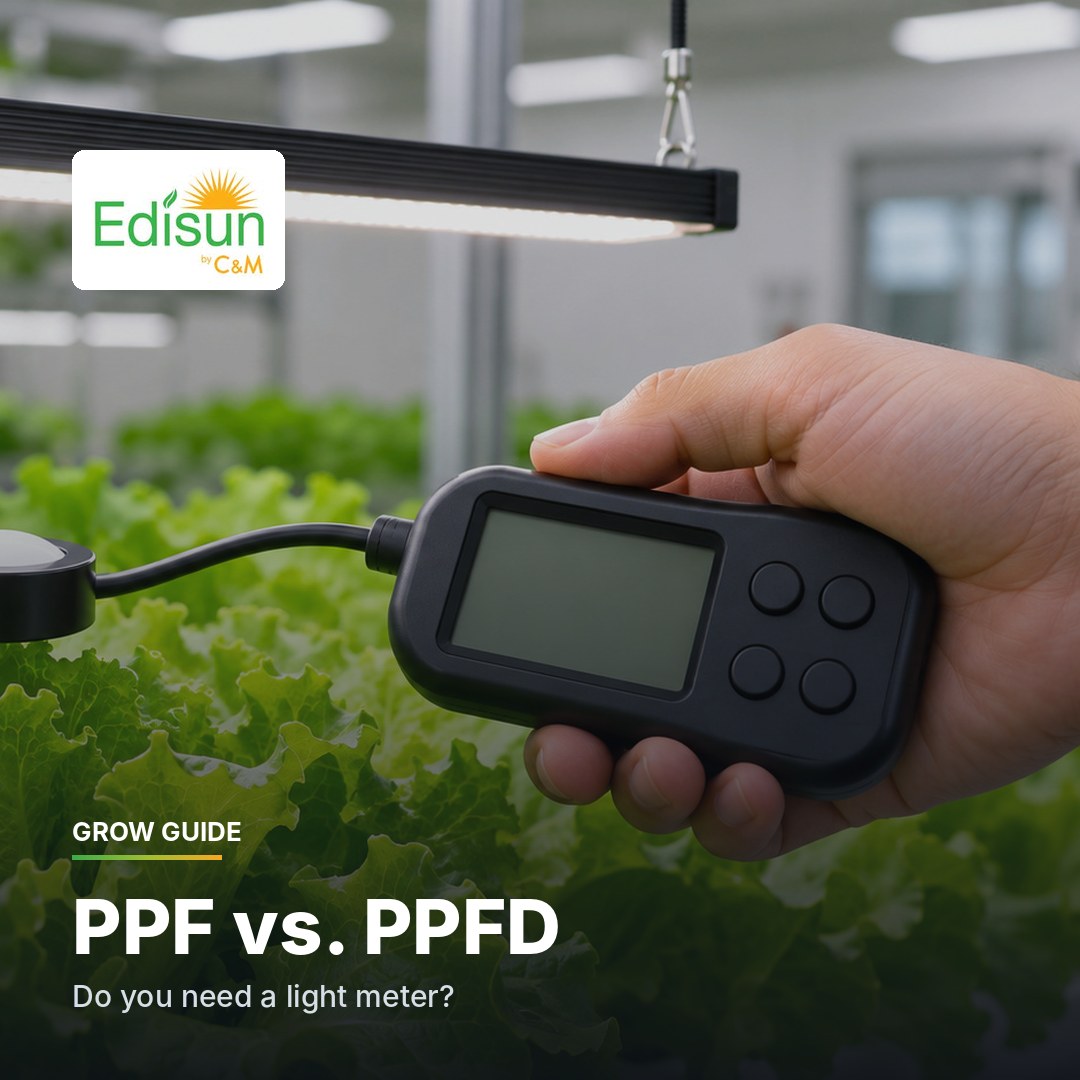
Do you need a light meter?
For most home growers, no. Start from the spec sheet and the estimate above, dim to suit your crop, and watch the plants: stretched, pale growth means too little light; bleached or curled leaves at the top mean too much. See when to dim your grow light.
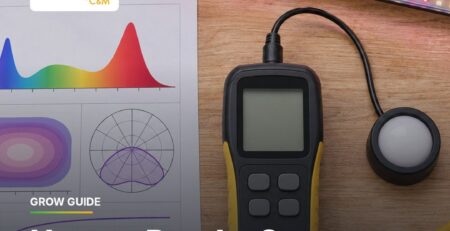
For commercial growers, yes. A quantum (PAR) sensor reads PPFD directly at the canopy. Runkle recommends checking the light delivered after installation with a quantum sensor at night, when sunlight doesn’t skew the reading.
What kind of meter?
Quantum (PAR) sensor: the right tool. Even these vary: LI-COR notes some sensors “can introduce significant errors when measuring light from artificial sources,” because each sensor responds a little differently across the spectrum. Choose a full-spectrum sensor rated for LED light.
Lux or foot-candle meter: not a good fit. Lux is weighted to human vision, which Runkle notes “is not relevant for plant applications.” Converting lux to PPFD changes with the light’s spectrum.
Phone apps: handy for rough comparisons between spots in the same room, but they rely on the phone’s camera sensor, so treat readings as estimates, not measurements.
How to measure
Measure at the top of the canopy, sensor level and facing up.
Take readings in a grid: center, corners and edges. The average tells you if you’re on target; the spread tells you how even the light is.
In a greenhouse, measure at night to see what the lights alone deliver.
The bottom line
Compare lights by PPF and efficacy. Set up your grow by PPFD. Estimate it from the spec sheet, and measure it with a quantum sensor if you’re running a commercial operation.