Late winter is when gardens get started indoors, and it’s also when sunlight is weakest. That’s why so many seedlings come out tall, pale and floppy. A grow light fixes that. Here’s how much light seedlings need, how to set one up, and when to sow each crop.
Why a windowsill isn’t enough
University of Minnesota Extension puts it plainly: “A windowsill is not a good location for starting seeds.” Windows are often the coldest spot in the house at night and the hottest by day, and “lack of light is the major cause of elongated, skinny stems.” University of Maryland Extension adds that window light “is seldom enough for good, strong seedling growth,” outside of south-facing bay windows and sunrooms.
Signs your seedlings need more light: stretched, thin stems with lots of space between the leaves, pale color, and plants leaning hard toward the window. More light afterward won’t shorten a stem that has already stretched, so start with enough light from day one.
How much light seedlings need
Growers measure a day’s light as the daily light integral (DLI). University of New Hampshire Extension plans around 12 mol/m²/day for seedlings. Michigan State University research on vegetable transplants found the benefit of extra light tapers off above a DLI of about 10–12.
To turn that into a setting for your light:
PPFD = DLI ÷ (hours of light × 0.0036)
Hours of light
PPFD for a DLI of 10
PPFD for a DLI of 12
14
about 200
about 240
16
about 175
about 210
Minnesota Extension recommends 12 to 16 hours of light a day, and says not to leave lights on around the clock. A plug-in timer keeps the schedule steady. See our guide to grow light schedules.
How close to hang the light
Old seed-starting advice says to keep lights 2–4 inches above seedlings. That advice comes from fluorescent shop lights, which put out little light. A modern LED grow light is far brighter, and our Edisun fixtures should hang at least 12 inches above the plants.
Instead of lowering the light, dim it. At full power, an Edisun FXL-320 over a 2×4 ft shelf puts out roughly 860 µmol/m²/s, about four times what seedlings need. Dimmed to roughly a quarter, it lands right in the seedling range. Every Edisun light dims to 10%, so you can start low and turn it up as plants grow. See when to dim your grow light.
When to sow
Count back from your area’s average last frost date. University of Maryland Extension suggests:
Crop
Sow indoors before transplanting
Peppers, eggplant
8 weeks
Broccoli, cabbage
8 weeks
Tomatoes
6–7 weeks
Cucumbers, squash
4 weeks or less
Starting too early is a common mistake. Seedlings that wait too long indoors outgrow their pots and get leggy anyway.
Choosing a light for seed starting
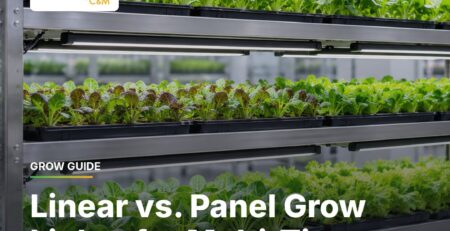
A shelf or rack of trays: a linear bar like the Edisun FXL-320 covers a 2×4 ft shelf evenly, and dims down for seedlings. See our rack setup guide.
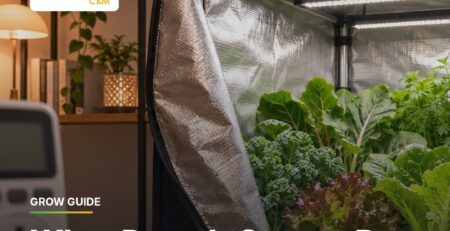
A grow tent: an Edisun LIT UFO hangs from one hook and lights a small tent. Run it low for seedlings, then turn it up as plants grow.
Look for dimming. A light that only runs at full power is too strong for seedlings unless you hang it very high.
Seed-starting checklist
Count back from your last frost date and sow on schedule.
Set the light at least 12 inches above the trays and dim it to about 175–240 µmol/m²/s.
Run it 12–16 hours a day on a timer.
Watch for stretching, and raise the intensity if stems get leggy.
Harden seedlings off outdoors for a week before transplanting.