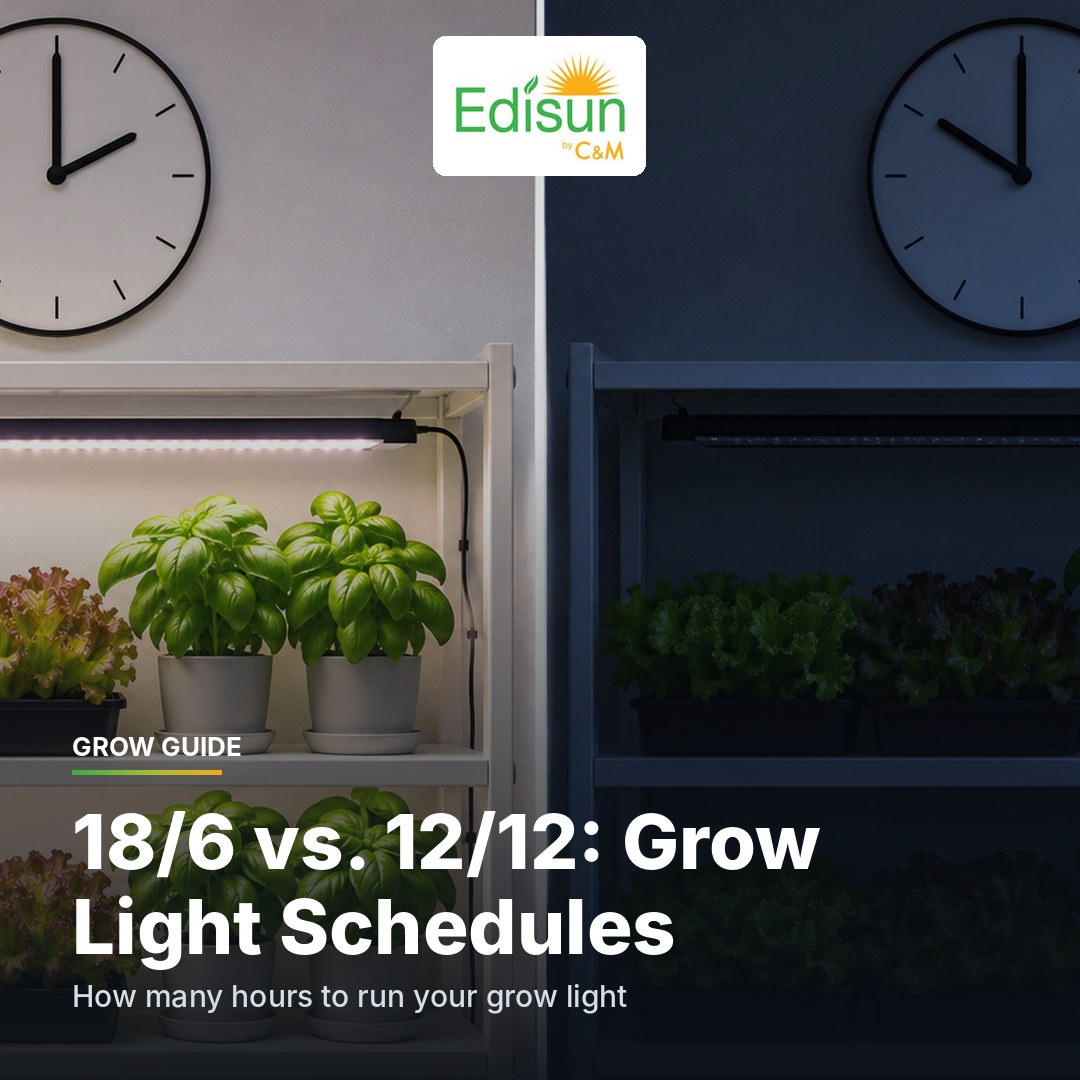
“18/6” and “12/12” are shorthand for how many hours a grow light runs, followed by how many hours it stays dark. The right schedule depends on two things: how much total light your crop needs each day, and whether day length controls when it flowers. Get both right and you grow faster without wasting power.
The common schedules
Schedule
Light / dark
Typical use
24/0
Continuous light
Lettuce in some studies (see below); not for short-day flowering crops
18/6
18 h on, 6 h off
Seedlings, leafy greens, herbs, vegetative growth
16/8
16 h on, 8 h off
Seedlings, greens, herbs; a common default
12/12
12 h on, 12 h off
Flowering short-day crops
Day length controls flowering in many plants
Plants fall into three groups by how they respond to day length, according to Oregon State University Extension:
Short-day plants flower when days are shorter than about 12 hours. Examples: chrysanthemums, poinsettias and Christmas cactus. Long days keep them from setting buds.
Long-day plants flower only when they get more than about 12 hours of light. Examples: lettuce, spinach, asters and coneflowers.
Day-neutral plants flower regardless of day length. Examples: tomatoes, cucumbers and some strawberries.
What the plant actually measures is the length of the uninterrupted dark period. For short-day crops, a light leak in the middle of the night can be enough to stop flowering. Keep grow rooms and tents fully dark during the off period.
Hours and intensity trade off
For most crops, growth depends on the total light received in a day: the daily light integral (DLI). You can hit the same DLI with a brighter light for fewer hours or a dimmer light for more hours.
DLI = PPFD × hours of light × 0.0036
Target DLI
PPFD at 12 h
PPFD at 16 h
PPFD at 18 h
10
230
175
155
14
325
245
215
20
465
350
310
Longer days at lower intensity can grow more. In a Michigan State University study on hydroponic lettuce, extending the day from 16 to 24 hours at the same intensity (150 µmol/m²/s) raised fresh weight by 53–59%. At the highest DLI tested, a lower intensity with continuous light gave the highest yield. That study covered lettuce only, so check crop-specific guidance before running other crops around the clock.
What each schedule costs to run
A light costs the same per hour no matter which schedule it’s on, so an 18-hour schedule uses 50% more electricity than a 12-hour one. But if a longer day lets you run the light dimmer and still hit your DLI, the cost evens out. See what it costs to run a grow light for the math and a calculator.
Every Edisun grow light dims down to 10%, so you can stretch the day and lower the intensity to hit the same DLI. See when to dim your grow light.
Setting your schedule
Find out how your crop responds to day length. Short-day crops need long, uninterrupted nights to flower.
Pick a DLI target for the crop and stage.
Choose the hours, then set the intensity to reach the DLI. Confirm with a PAR meter at canopy height.
Use a timer. A consistent schedule matters more than the exact hours.
Block light leaks during the dark period, especially for short-day crops.