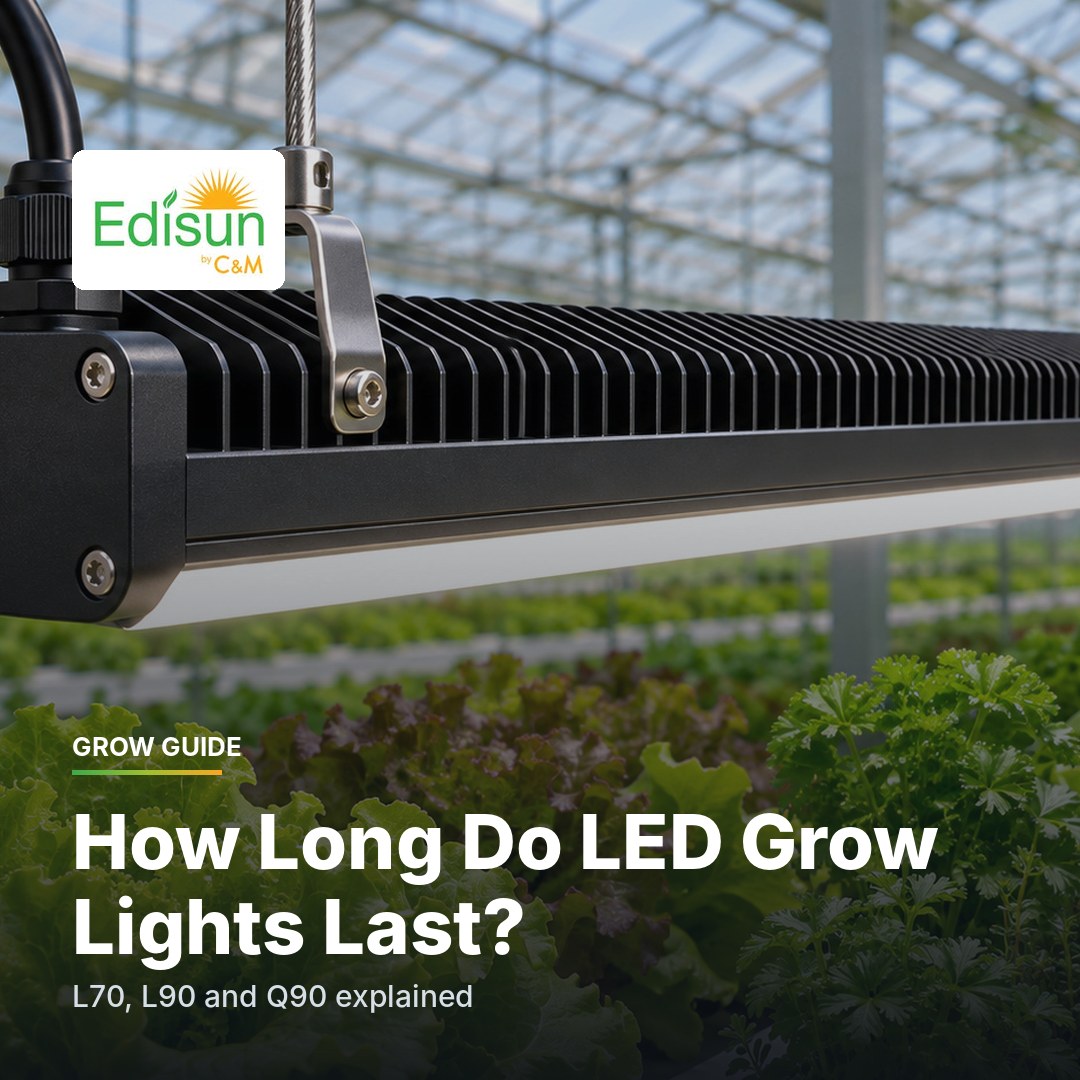
A high-pressure sodium lamp burns out after about 10,000 hours. An LED grow light is usually rated for 50,000 hours or more. But LEDs age differently: instead of burning out, they slowly get dimmer. Here’s what the ratings mean and how to make a light last.
LEDs fade instead of failing
The U.S. Department of Energy notes that LED packages “rarely fail catastrophically.” Instead, their output slowly declines over thousands of hours. So an LED’s “lifetime” is the point where it has dimmed by a set amount, not the point where it goes dark.
Reading the lifetime ratings
Rating
What it means
L70
Hours until light output drops to 70% of new. The common rating for general lighting.
L90
Hours until output drops to 90% of new. A stricter standard.
Q90
Hours until photon output (plant light) drops to 90%. Used for horticultural lights.
DOE adds a detail most spec sheets skip: ratings are usually L70-B50, the point at which half of a sample of products is expected to reach L70. Some units will dim faster, some slower.
For grow lights, the DesignLights Consortium’s horticultural specification requires a Q90 of at least 36,000 hours and a driver rated for more than 50,000 hours.
Where the numbers come from
LM-80 is the lab test that measures how LED packages hold their output over time.
TM-21 is the method for projecting that data forward to estimate lifetime.
DOE cautions that TM-21 projections only estimate one way a light can fail: gradual dimming. They say nothing about the driver or other parts.
What actually wears out first
The LEDs themselves usually outlast the rest of the fixture. DOE calls the driver “the weak link for some currently available LED products,” and its life is “strongly dependent on operating temperature.” Dirt on heat sinks and aging lenses also take a toll.
A fixture’s real-world life can’t exceed that of its weakest part.
What 50,000 hours means in years
The Edisun FXL is rated for 50,000 hours.
Hours per day
Hours per year
50,000 hours lasts
12
4,380
about 11 years
16
5,840
about 8.5 years
18
6,570
about 7.5 years
Compare high-pressure sodium lamps, typically replaced every 10,000–15,000 hours. See LED vs. HPS for greenhouses.
Dim when you can. Running below full power reduces heat and stress, and saves power. See when to dim your grow light.
Keep it clean. Dust on the lens blocks light; dust on the heat sink traps heat. Wipe fixtures down between crops.
Match the rating to the room. In humid or wash-down spaces, use a sealed fixture. Edisun lights are IP66. See what IP65 means for a grow light.
Protect the power. Surge protection and a stable supply help drivers last.
Planning for gradual dimming
Because LEDs fade slowly, a light that delivers exactly the PPFD you need on day one will deliver less in year five. Many growers size lights with a little headroom and dim them down when new, then turn them up as they age. Check the light at the canopy with a quantum sensor once a year. See PPF vs. PPFD.