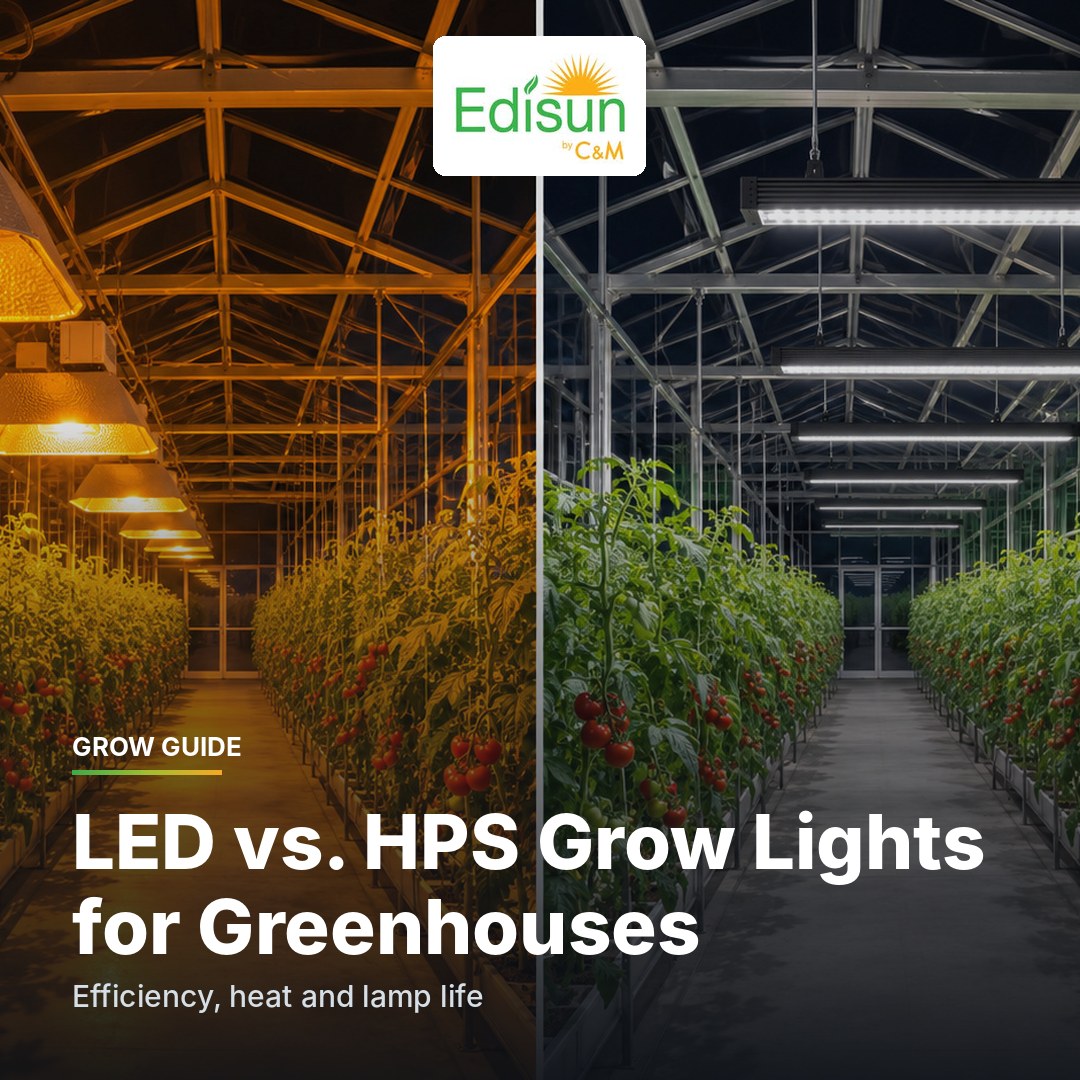
High-pressure sodium (HPS) lamps lit greenhouses for decades. Most new installs now go LED. Here’s how the two actually compare, including where HPS still holds its own.
Light per watt
The number that matters is photosynthetic efficacy: micromoles of plant-usable light (µmol) per joule of electricity. Higher means more light for the same power bill.
Fixture
Efficacy (µmol/J)
400W HPS, magnetic ballast
0.94
1000W double-ended HPS, electronic ballast
1.70
LED fixtures on the DLC horticultural list
2.39–3.19
Edisun FXL-320 / FXL-600
2.63 / 2.65
Michigan State’s Erik Runkle sums up the current state: LED fixtures are now “at least 35% more efficient” than HPS. Against an older magnetic-ballast HPS, a modern LED bar gives well over twice the light per watt.
One honest note: not every LED beats the best HPS. Our Edisun LIT UFOs (1.42–1.46 µmol/J) are made for tents and small rooms, and a double-ended HPS outdoes them per watt. For greenhouse supplemental lighting, use a high-efficacy bar like the Edisun FXL.
What happens to the heating bill
HPS lamps throw a lot of radiant heat at the crop. In a cold greenhouse, some of that heat is useful. Switch to LED and the lighting bill drops, but the heater runs a little more.
A Wageningen University modeling study (Katzin et al., 2021) put numbers on the trade-off for a tomato greenhouse:
Lighting energy fell about 40%.
Heating energy rose 9–49%, depending on climate.
Total energy use still fell 10–25%.
So LEDs save money even after the extra heating, just less than the lighting numbers alone suggest. Measured canopy effects vary: a USDA-ARS comparison found HPS changed leaf temperature by anywhere from −0.6 to +1.7 °C relative to LED. For more on LED heat, see do LED grow lights need extra cooling?
Lamp replacement
HPS lamps wear out and dim as they age:
Standard mogul-base HPS lamps are typically replaced around 10,000 hours; double-ended lamps around 10,000–15,000 hours (Lopez, Purdue).
Runkle notes HPS lamps are often changed at about 12,000 hours, when they’re down to 85–90% of their original output.
At 16 hours a night through a long winter, that’s a new lamp every two years or so, plus the labor of getting up to change them. The Edisun FXL is rated for 50,000 hours.
Shading and control
Shading: a big HPS fixture and reflector cast a shadow on the crop all day. A slim LED bar (the FXL is 2.9″ wide) blocks far less sunlight.