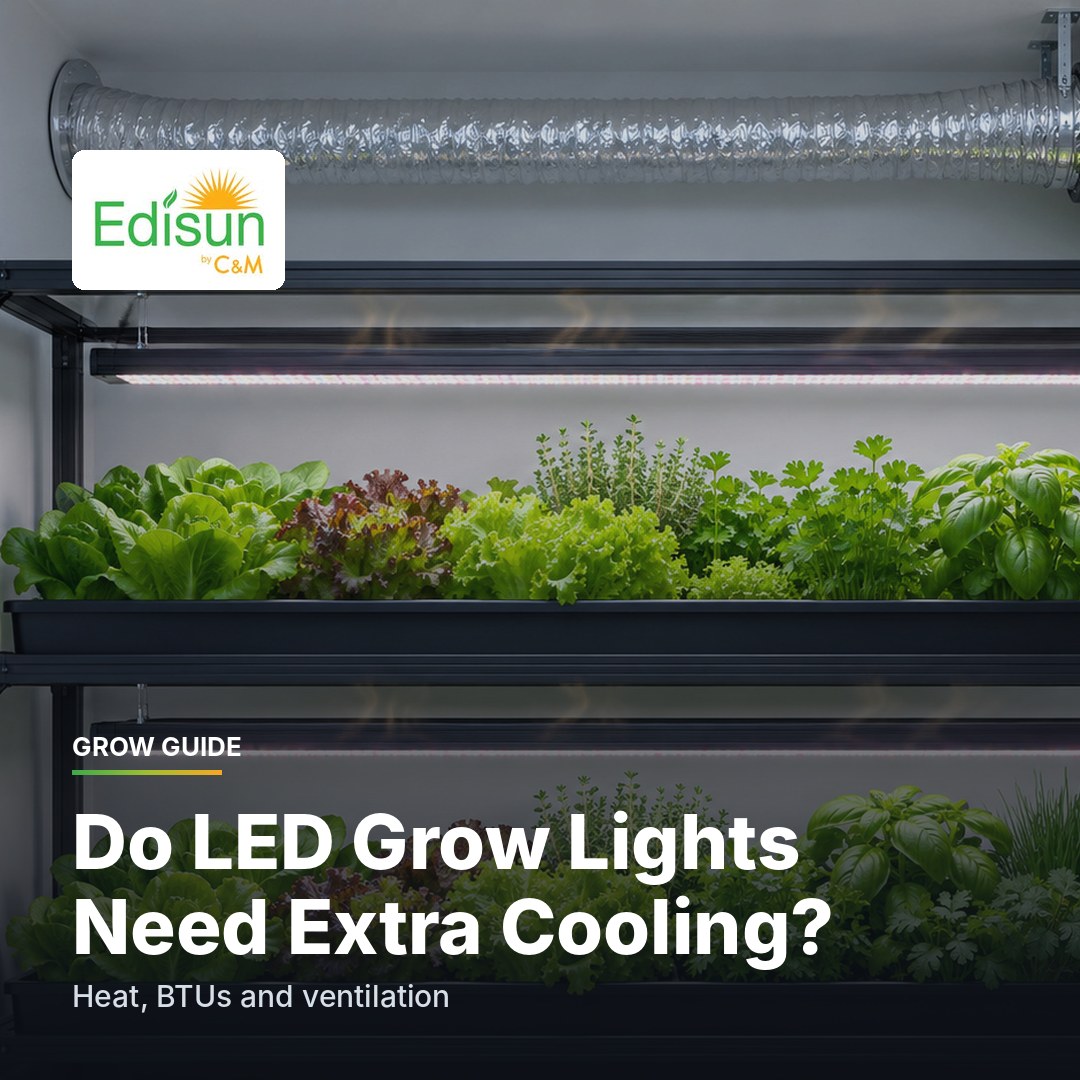
LED grow lights are known for running cool. That’s partly true: they put much less heat on the plants than old HPS lamps. But a grow light still turns every watt it uses into heat sooner or later. Here’s how much, where it goes, and when you need to deal with it.
Every watt becomes heat
Whatever a light plugs in for ends up as heat in the room. Most leaves the fixture as warmth right away; the light that reaches the plants turns to heat when it’s absorbed. So a 320W light adds 320W of heat to your grow space, whether it’s LED or HPS.
To size ventilation or air conditioning, convert watts to BTUs. Mississippi State Extension uses 3,412 BTU per kilowatt-hour:
BTU per hour = watts × 3.412
Fixture (at full power)
Heat added
Edisun LIT-150 (150W)
about 510 BTU/hr
Edisun LIT-240 (240W)
about 820 BTU/hr
Edisun FXL-320 (~320W)
about 1,090 BTU/hr
Edisun FXL-600 (~600W)
about 2,050 BTU/hr
For comparison, a small window air conditioner removes about 5,000–6,000 BTU/hr. Dimming cuts the heat in step with the watts: an FXL-320 running at half power adds about half as much.
So why do LEDs feel cooler?
Two reasons.
They make more light per watt. An Edisun FXL turns out 2.63 µmol of light per joule; a 1000W double-ended HPS manages about 1.70. To deliver the same light to your plants, the LED draws less power, so it makes less total heat. (Utah State’s Bruce Bugbee points out that an LED and an HPS of equal efficacy would make equal heat. The savings come from efficacy, not from LED being magic.)
The heat goes somewhere else. An HPS lamp beams much of its heat at the plants as infrared. An LED releases its heat into the air through its heat sink, up and away from the canopy. Nelson and Bugbee found leaves under LED ran about 1.3 °C cooler than under HPS at the same light level, and plants used about 17% less water through their leaves.
That cooler leaf can be a surprise when you switch from HPS. Plants may want the room a couple of degrees warmer, and they’ll drink a little less.
Does the light itself need cooling?
LEDs run best cool. Research by Kusuma and colleagues found LED efficacy drops about 10% as the chips heat from 25 °C to 85 °C. Edisun fixtures use aluminum housings to shed that heat into the air. You don’t need water cooling or extra fans on the fixture. Just:
Leave space around and above the fixture so warm air can rise away.
Keep air moving through the tent or room, especially in multi-tier racks where heat can build up under each shelf. See the rack setup guide.
Don’t wrap or box the fixture in.
When you do need extra ventilation or AC
A small tent with one light: an inline fan that changes the air every few minutes is usually enough.
A closed grow room with several lights: add up the watts and convert to BTUs, then size ventilation or AC to remove that heat plus whatever the room gets from outside. A room with four FXL-600s adds roughly 8,000 BTU/hr at full power.
Hot summers: run lights at night when it’s cooler outside, and dim if the room overheats. See grow light schedules.
In a winter greenhouse, the opposite applies: LED heat that used to come from HPS now has to come from the heater. See LED vs. HPS for greenhouses.
The short answer
LED grow lights don’t need special cooling, but your space needs to get rid of their heat like any other appliance. Count the watts, convert to BTUs, and ventilate to match.